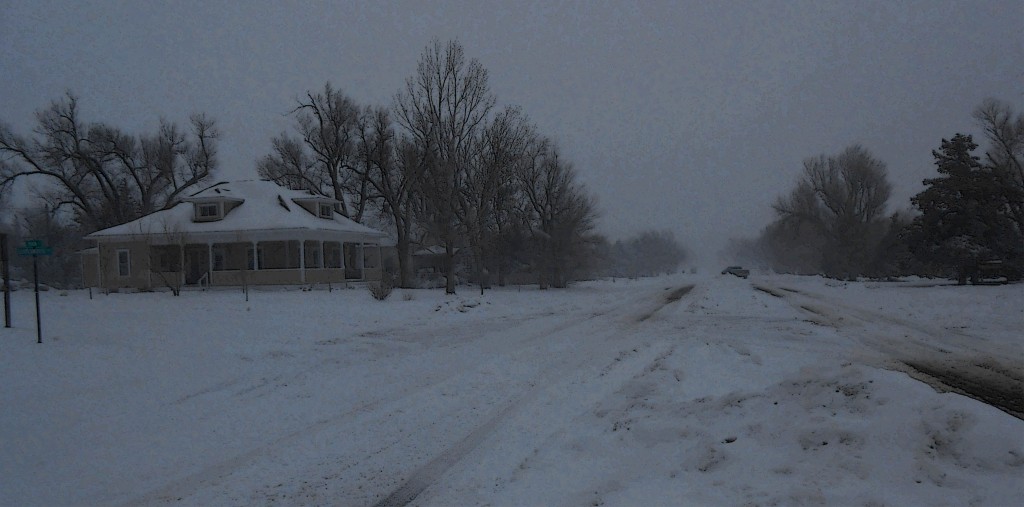
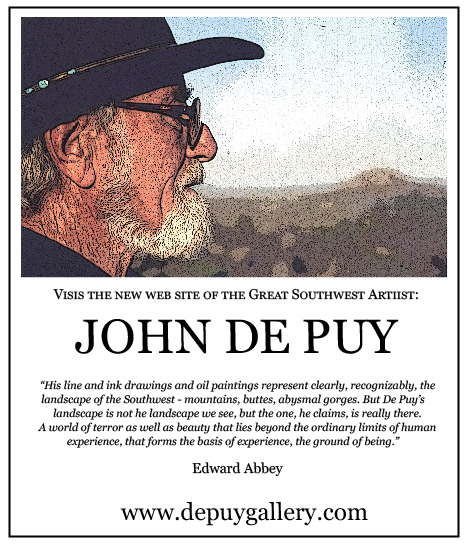
 Last month I traveled to New Mexico to visit John and Isabel Depuy and their 16 month old daughter Noelle. John gave me explicit directions to his desert stronghold, some 50 miles south of Taos, and I never became lost once. But had it not been for Isabel’s red balloon tied to the cattle gate, I might still be wandering about.
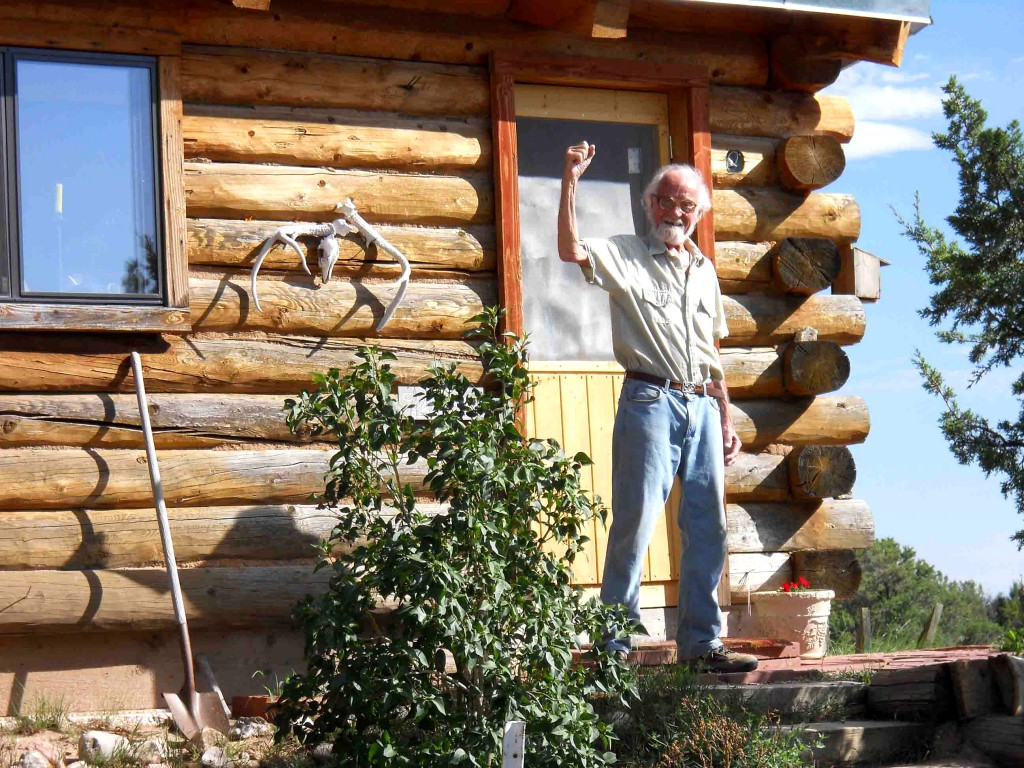
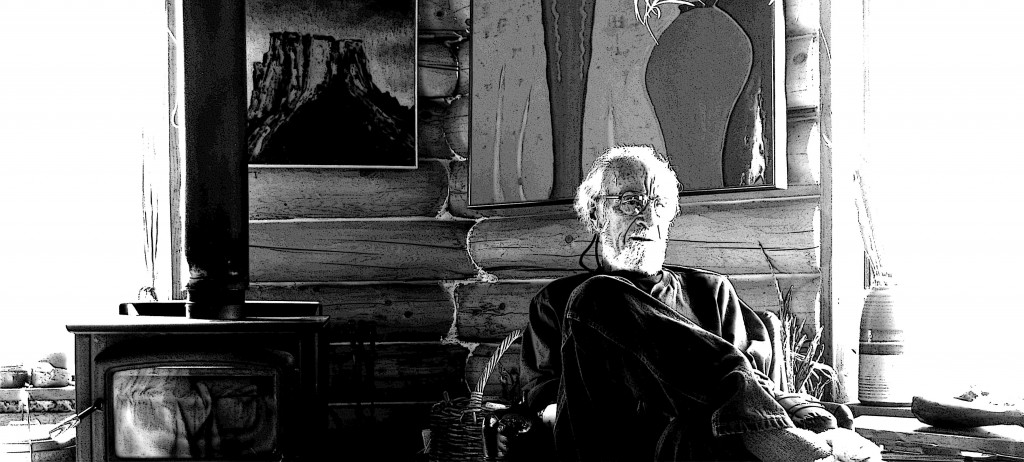
The Depuys truly live at the edge of the world. Their unobstructed view across fifty miles of desert and table lands is indescribable. They live in an eight-sided cabin, hogan-style, with a photo-voltaic panel for power and a roof-top water collection system that just barely manages to stave off thirst. They are literally at the end of the road.
Depuy arises an hour before dawn with all the vigor and enthusiasm of a man half his 78 years. He brought me Earl Grey tea at 6 am and was ready to attack another canvas by seven.
On this day, however, I made him set his paints and brushes aside for a few hours, so he could tell me the story of, or at least a small excerpt from, his remarkable life, including his 30 year friendship with Edward Abbey.
If being a friend of Abbey’s has been a disadvantage of any kind, it might be the way his enormous personality and talent dwarfed the rest of us. Some of us have become better known as “a friend of Abbey” than the sum of our own accomplishments.
That certainly cannot be said of Depuy. Beyond his extraordinary gifts as a great artist, he is a man without equal. No one on this planet is anything like John Depuy. I’m sure Ed Abbey recognized that unique quality the first time they met, albeit in a drunken stupor. And it is why they stayed closer than brothers until Abbey’s death in 1989.
But DEPUY! lives on…he claims he’ll reach 105 and beyond and I believe him. He’s even promised to pour a good bottle of Scotch, first filtered through his kidneys, on my own grave. When that time comes. I’m counting on Depuy to be there.
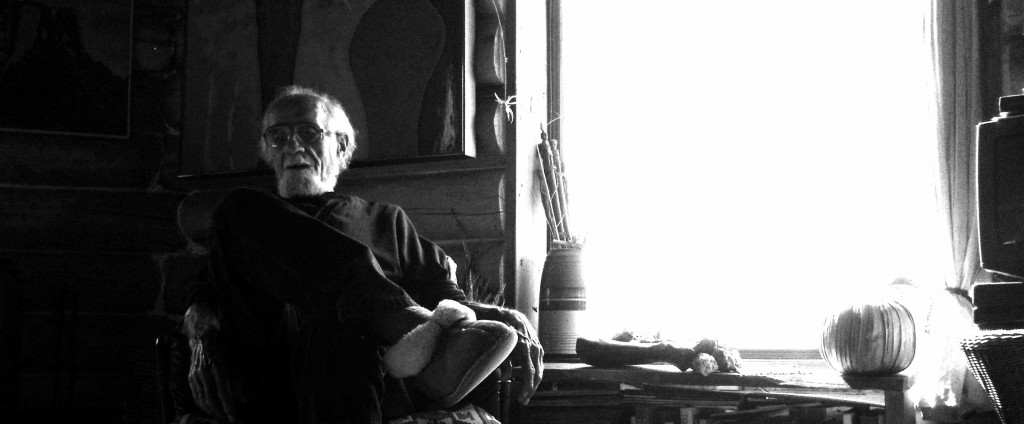
THE INTERVIEW…
JS: So, it’s as if the American Southwest was a part of you from the time you were born.
JD: Yeah, my grandfather had a ranch in Texas. And he lost everything in the Depression, went down the drain, the bank took everything, the ranch, furniture, everything. So, we had to move for about two years to, of all places, southern New Jersey…the Pine Barrens. My father went to sea as a First Mate during the Depression, kept us all alive. Losing the ranch broke my grandfather’s heart. He hated the East. He thought everything east to the 100th meridian was barbaric and people there were little more than slaves, industrial slaves.
So, in 1880, he quit, walked down in the hole and came out here to New Mexico. Then he homesteaded a ranch near Sun first Navoo? And that lasted up until the thirties and the Depression wiped him out, so we came back …I came back around ’52, right after Korea with that nice fat pension.
Tell me about Korea and your experience.
I was in the Navy Reserves, my father was a Navy man. So when I was 17, he took me down and signed me up for the Reserves and I thought nothing of it. World War II was over and I was sure there wouldn’t be any new wars for a while. Then the Korean War broke loose; I was studying at Columbia University in Anthropology. I was in a good school at that time and bang the big war broke loose and they called me back. I spent some time at the Brooklyn Navy Yard in the early days and a little time before that on a destroyer APB.
They were shooting medics in Korea. They used the Red Cross for target practice and the North Koreans pushed all the down almost to Puysan. They yanked me off the ship and they sent me back to Brooklyn yard, lined up for a uniform and I said, “Well, I’ve got a uniform for the Navy.” And I looked at all of these olive drab uniforms and I said, “I’m not in the Marine Corps.” The sergeant said, “You are now, buddy. You’re a medic.” The mortality rate was something like 50 percent for medics; I only lasted three months on the perimeter of Puysan. We were picking up a body and it turned out to be mined—it blew up.
I was leaning down and so it blew my hip off or parts of it and my buddy was beheaded. I woke up three days later in a hospital ship and everything was white. I was unconscious for three days and it was white—I saw this white figure with beautiful long blonde hair and I said, “There is a heaven, goddammit.”
It was a nurse. I was sure I was dead—I went to Philadelphia Naval Hospital and they started poking at my legs and started rebuilding the hip. The first two attempts failed and they tried again. First, they put in a Teflon ball for a hip joint and that didn’’t work so they yanked it out and they stuck in a Titanium ball and that did the job.
Then they wanted to do more surgery, poking around and I said, “Screw this.” I could walk by then, so I just went over the hill. AWOL. I climbed the fence, went out and hitchhiked across the country to the Navajo Reservation from back east. I had five bucks to my name and I ate peanuts and raisins the whole way out. I got a job in Flagstaff, pumping gas for a few days. The guy knew I was interested in Native Americans and so he said, you know I bet the Cap Trading Post needs somebody and I took the job there for a while. I found out they were screwing the Navajos, so when I weighed flour or sugar, I gave them twice as they paid for. That lasted about two weeks and I got fired.
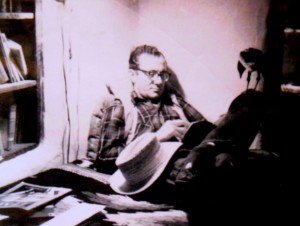 I was going under the name of Thoreau then…I was John Thoreau for my hero Henry David and then I got fired and I took my pack and I hiked down the road, intending on hitchhiking somewhere—I don’t know where—New Mexico probably. And then a whole truckload of Navajos came by and they knew who I was because I was helping them out. And they said, “Hop in the back.” I did and they took me out over the Gap near the Vermillion Cliffs to a hogan, a beautiful little..one of the old fashioned ones and they said, “This is yours.” So, I stayed there for a time, a number of months there…and then I went out to Navajo Mountain and for some reason, I can’t remember why, somebody introduced me to Long Salt, a hataali, a medicine man. And Long Salt talked to me and he said, “You’re in bad shape. You’re in bad shape.”
He said, “You’re dying, you stay here with me and I’ll bring you back to life. He was 90 at that time.” I stayed with him for almost twelve months and he taught me to be his assistant in the sand paintings and I would grind the paints then put them in the abalone shell and I learned to create the different pigments.
He sent me on a spirit quest, fasting, sitting up on top of Navajo Mountain——I went out of my mind—the purpose of this, he told me was to find my spirit side. After a week of fasting, a week of sitting there, I started seeing all kinds of things. I don’t remember if it was reality or fantasy but a raven came and sat at my feet and then another day three coyotes sat with me. Finally I came down and told him about this. I asked him whether it was a dream and he said, “Those are your spirit guides Coyote and Raven…As long as you’re good to coyote and raven, you’ll be fine.”
He wanted me to marry his niece, who was a nurse in Tuba City but I was yopung, I wanted to go back to school, I wanted to paint, I wanted to live a whole life. He wanted to adopt me. He even gave me a Navajo name..I’m not even going to try to pronounce it, but it means Dawn Walker, but I decided, no, I’ve got to go back so I left and went to Santa Fe and I worked at Folk Art Museum. At some point the director of the museum wrote back East some information about me. A few days later, I came home and there’s a big black limo in front of my house and an aerial hanging out of it. He said, “FBI…Mr. Thoreau, you’re Mr. John Depuy.”
He hauled me off and threw me in the Santa Fe County Jail and then transferred me to the Albuquerque County Jail. The same jail as the one depicted in the film Brave Cowboy, the film based on Ed’s book. The same jail. The Navy was having a hard time getting my papers and meanwhile, I was rotting in this damn jail with a bunch a drunks, and killers. Finally, I said, I’ve got to get out of here and I started running up and down the aisles, yelling at the top of my lungs, “More guns, less butter! Man was made for war…Woman was made for procreation!”
They decided I was off my bloody rocker, so they finally got the Navy to pick me up. I went to Corpus Christi first and then sent me back to the Philadelphia Naval Hospital. After a long hassle, they had a court martial and luckily they appointed a sympathetic shrink to decide why the hell I went and lived on the reservation; he asked me, “Why did you go live with the Navajo, what was that all about?” I said, “I was looking for God.” And just handed this shrink a line of bullshit, about half of it true.
Nobody would believe me, living with a hataali? Especially in 1952? And even before the trial I was doing watercolors in jail and the shrink liked my work. So, I went to the court martial and I’m sitting there listening to all this bureaucracy going on and then the day of judgement comes, just more crap and then I hear this guy stand up and say, “You are awarded 80 percent disability for life.”
Oh, my god, I was free, free! Then there was this GI Bill Public Law 16?, which was for disabled veterans……
So, you got your 80 percent disability………….
And I was free, free as a lark, walked out of that Naval Hospital, had the GI bill, I studied for a while with Hans Hoffman from the Bauhaus in New York. He was Bauhaus German, then I went over to Oxford from the GI Bill to do graduate work in art history. Ed Abbey went about that same time to Edinburgh because of Robert Burns. I spent some time there and then after wandering around, came a new wife, child born in Oxford and came back home.
I returned to Taos…home. One day I went to Santa Fe with this lady, Rini Templeton. Kind of a good Bolshevik. A very good Bolshevik. We were wandering around the plaza, had a few drinks. And suddenly this big ape appeared, also ripped to the gills. And Rini said something like, “You two are beyond hope.” She introduced me to him because she was the art editor of a paper that this man had just taken over as editor. We were both drunk and she sort of propped both of us up, unlike he said in the book. She held both of us up to go to this concert.
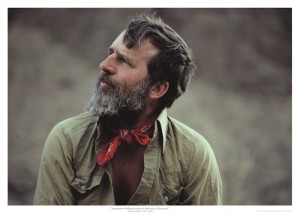 This turned out to be Edward Abbey…he was singing some damn litany about something like, “I’m the boss now the working class can kiss my ass” He was singing in this drunken manner. And we went to the concert which starred Odetta—she was kind of a heroine for everybody in those days, in the late 50s. She was the great black goddess of the day and Abbey, of course, fell instantly in love with her. After the concert we managed to wheedle our way back stage. We wanted to show her Taos–it was Christmas time— and she was ready to go and she said, “Let me get my bags.” But her business manager walked in and said, “There’s no way on earth you’’re going with these two maniacs.” So, she didn’t come.
So Ed took over the Taos paper, this was in ’59. The publisher of the paper was a devout Marxist. Abbey was an absolutely devout anarchist––he even wrote his thesis on the subject. And they clashed head on. So, the paper struggled along for about a year with these two. Finally Ed wrote an editorial exposing his publisher’s political bent. “I admit, I’m a devoted anarchist; why the hell doesn’t he admit, he’s a devoted Marxist?” About two months later, the paper folded. There was lot of public discussion. The boss was furious and went into hiding. One night, Ed and Rini and I were walking down near the plaza in Taos when we were spotted by some members of the American Legion. They chased us with a baseball bat. They wanted to beat the pulp out of us, but luckily we ran like dogs and got away.
Ed hung around Taos writing—his wife thought he was a bum and I was still painting. We were both drinking a lot. It was during that period that the origins of “The Monkey Wrench Gang” began to take root. It was just before the paper folded. This absolute idiot had come to Las Vegas, New Mexico; he owned the Melody Sign Company and he put up about 12 immense, forty foot signs north of Taos. They were the most hideous things you’ve ever seen.
What were they promoting?
Everything—cars and all kinds of things. Well, one night, we decided we’d go out there and remove them with a chainsaw. But we were working on about number eight and we hear this other crew coming up the arroyo. We thought, oh, my god we’re trapped, so we dove for shelter. But it turned out to be the town councilmen, the town pharmacist and the town poet and so we had so a kind of reunion. Neither party knew the other one was there, so it was hysterical. And then, we demolished them. About a week later the owner of the sign company came all the way over from Las Vegas to put an ad in the paper for the apprehension of these criminals and Ed, of course, being the editor took the ad and burst out laughing. Mr. Melody, that was his name, said, “What are you laughing about?” and Ed said, “Just something I thought about.” And he put up a $2,000 reward for the apprehension of the culprits. It was good bucks in those days. Ed told me about it and later said, “I seriously thought about turning you in and skipping town.”
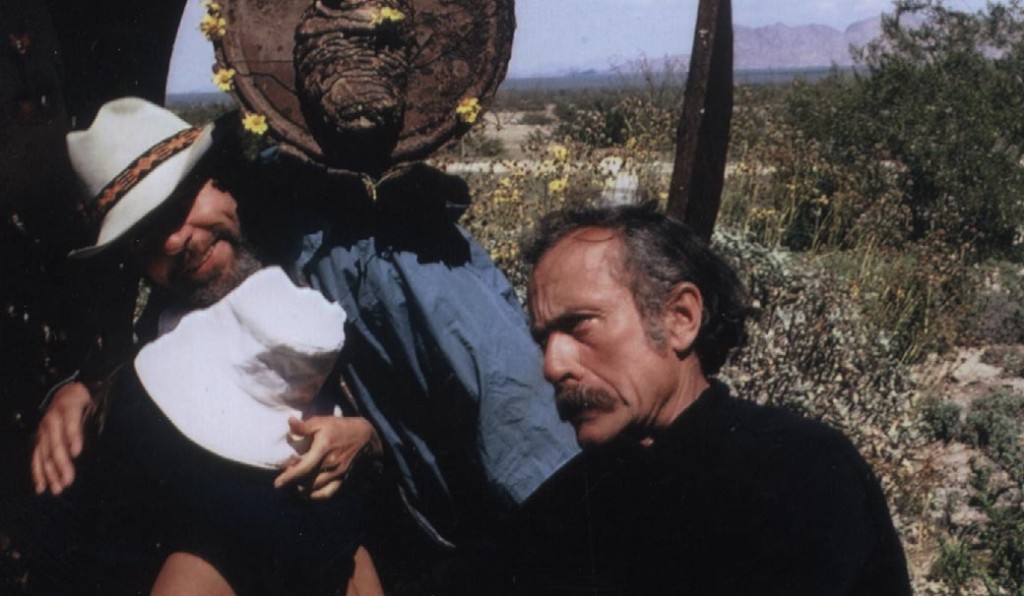
What was your personal life like at this time?
Oh, semi-chaotic. Rita and Ed were having serious problems. Rita thought Ed was just a bum; one day, right in the kitchen, she told him he was good for nothing but stretching her canvases….Rita was quite a successful painter. It wasn’t too long after that, Ed had a chance to go out to Utah and work at Arches again. She wanted him to go back to Hoboken and work as a caseworker—she laid the law down with an ultimatum, either you come back to Hoboken or I leave you. He went Arches.
Your marriage was a bit shaky; you might want to tell the story of Schiller’s Ode to Joy.
Oh, my god, both our marriages were on the rocks. I had three kids, Ed had two. It was getting worse and worse. It was getting to the point where we were half out of our minds. Then one day in Santa Fe, reaching the bottom of the pit, we decided to go over to Claude’s Bar which was the only Bohemian bar in Santa Fe and have a few a drinks. We were sitting over there moping over our beer and boiler makers—I need HELP—and in walks Creeley, Bob Creeley, the poet. He took one look at us and after about ten minutes, he says, “I’ve got to get out of here, you two are depressing me. You’re the most morbid couple of people, I’ve ever met.”
He was a famous poet, a part of the Beat period, just post-Beat. He split and we stayed there and closed the bar at two in the morning. We staggered out of the bar and onto the street. It was midwinter with ice all over, and Ed and I were singing Schiller’s Ode to Joy, Beethoven’s 9th. Joy of God these mortals,…brothers… Joyous…blah, blah, I only know this in German…and we got about to the middle of Canyon Run Road. We slipped on the ice and we both fell in the middle of the street. We’re lying in the middle of Canyon Run, laughing our heads off and right in the middle of this, down the road, a little red Porsche comes along. It’s Rita’s shrink, who also happened to be my wife Claudine’s shrink.
He was a real Nazi, a Freudian Nazi. He looked at us…first he almost ran us over us and then he got out of the car and examined us up close. He shook his head and yelled, “You two are Schwein, you two are the filth of the earth and I am reporting you to your wives and I am going to make sure that you never live with your children again. You are menaces, you are filth!” And that’s what happened.
So after the divorce, the wives, both of them Rita and Claudine got custody of the children, and that ended that chapter. Next chapter…
Now, what year was that?
Oh, god I can’t even remember. It was about the mid sixties. So do you want me to go into the grisly details of the rifle and the furniture?
Oh, absolutely! But just to clarify, this is the truth behind Abbey’s story “Hard Times in Santa Fe” that appeared in the first issue of the Zephyr and which is reprinted in this issue.
Well, all this followed our divorces. Everything had gone down the drain. I decided I had to get out of the country. I had a place in Santa fe but I decided to go over to the Mediterranean, I wanted to go to Morocco to hike, Atlas, I wanted to go to Crete and I wanted to see the Minoan Ruins, I wanted to go to the island where my ancestors are buried.
I told Ed, when I leave you can take over the house. Before I left I was selling everything I could find, trying to make enough money to get over on a freighter and one of the things I did was pawn, Ed’s rifle, his favorite rifle. I thought that when I came back—I didn’t know when I’d be back, but when I got back, I’d un-pawn it. But he found out that the damn thing was pawned and in revenge, he sold all the furniture in my house, the whole thing——just loaded it up and sold it. So, when I got back a year finally later there was nothing…it was stripped. So that was “Hard Times in Santa Fe,” but after the initial bunch of cursing and swearing at each other, we laughed our heads off and had a drink. Oh, god.
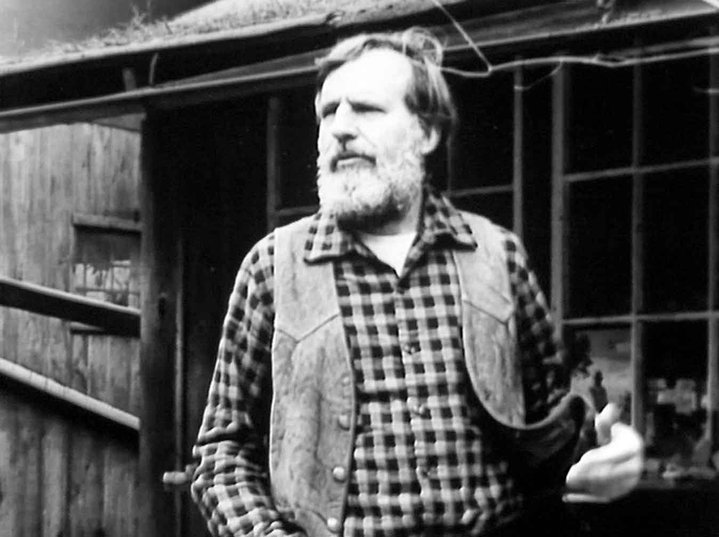 Where was the house that Abbey burned down?
That was near Albuquerque, He was a student at UNM and he was caretaking this house; he went to town from the house to do something and he left the fire burning in the fireplace and he came back and the house was burned to the ground.
That was before you met him?
Yeah, that was before I met him. Another time, you’ve heard the story when he put a bunch of tires in the crater outside of Albuquerque and set them on fire—huge black plumes of smoke came out of the crater. They thought it was a volcano and the whole town went ape shit. The cops were looking for the culprit because it caused car wrecks and pandemonium; they actually thought the volcano was going off.
But going back to the mid-60s, through all of this we both worked at our craft. We both worked like hell. I did some of my best work during this period. Like my “Land of Moab” series. He had finished Desert Solitaire, I think he was working on Black Sun.
We’re now up to the late 60s early 70s, you and Ed were together a lot when your father died and when his third wife Judy died.
God that was horrible, I think he wrote about it. We went to this rock shelter, this cave in the Grand Canyon—he had lost his wife and I had lost my father. I spent an entire summer with him and I think shortly after that, I think he was a ranger at Sunset Crater. I was with him there with the kids. His kids and my kids. I brought my oldest my daughter and I think one of ed’s son was there. I don’t know how he got a hold of Joshua. I know Joshua was there and that was when, I remember him talking about that snake, the two bull snakes that he described in Desert Solitaire.
Yeah, he was talking about that and also about Bates Wilson, the superintendent at Arches National Monument. He was a great supervisor. He was a gem. Back when the park had maybe 12 visitors a day?
Anyway we’d go out on his days off,––he was working as a fire lookout at North Rim, I’d make sketches and he’d write, long hand. He loved to write long hand. He even hated the goddamned typewriter; I don’t know what he’d do today with the computer shit. Now there’s computer art… CRAP…, it’s computerized crap; our brains are now computerized.
But back to the deaths…I saw Ed’s wife in the spring before she died. Oh god, it was awful. That affected Ed more than anything, oh god. He blamed her cancer on the nuclear tests because they were downwind… that’’s where his venomous, absolutely dedicated hatred with the whole industrial, military mess stems from. After that he was a very dedicated monkey wrencher.
What else happened during that time?
During some of this time, both Abbey and I were in New York. One thing that you’ve got to remember about both Ed and I, we love Manhattan, we had a passionate affair with the Big Apple and we loved it. We’d go there together, though not often. I had a show at a gallery and he had managed to get into a fight with his publisher at the show; it was a preliminary cocktail party for kissing ass. I was standing there in front of the goddamned punch bowl, just growing more and more morose with all the assholes that showed up. One guy started running his knuckle up and down my spine. This well-dressed New York bastard. I looked over at the gallery owner and said what the hell is this? And he said, “DePuy, if you’re going to make it in the art world, you’ve got to put up with certain things.”
I went ape shit, I picked up the whole punch bowl full of pineapple and vodka and dumped it over this asshole’s head. It turned out he was the biggest collector in Manhattan. So, the man went crazy and called the police but at that very moment, Abbey appeared at the door of the gallery, looked at the chaos and said, “Debris, out! Let’s get out of here, fast!” We went down to near the Village to a bar called the Cedar Bar, where all the Beats hung out. We got plowed. He had just had a fight with his editor; I had just blown the whole thing at the gallery. Then we staggered up from Washington Square on 5th Avenue, where we passed a big church like a cathedral and Ed said, “Goddammit, Debris, I want to go in there and pray.”
I said I wanted to stay away from the goddamn church. But he wouldn’t leave; the door was locked to this beautiful church and I don’t know how but he found a big beam of wood. Somewhere they were doing construction and he proceeded trying to break down the door…It was a big church, nice Gothic art. I can’t remember its name. Anyway the cops showed up, somebody called the cops. They showed up and dumped us both in the patrol car; luckily the cop, the sergeant was Irish and I told him my mother was born over in Dublin—he said, “What was your mother’s name?” I said Early and he said I knew Early’s In Dublin. I told him Ed was a yokel from somewhere out west and in his short time in the city, he’s lost his mind. And he said, I’m going to put you on the tubes to Hoboken and if I ever see you or hear of you in New York again, I’ll throw you in prison for the rest of your life. So, he escorted us to the tube, the subway going over to Hoboken and stood there watching us as we entered, saying, “Never come back by god.” So, that was it, the editor gave Ed a hard time, the gallery canceled the show. Although I still had a couple of shows after that.
But you know, as I told you before in my art. It’s the Germans who support me. They love my work because I evolved out of German expressionism and they love it, They love the design. They’re also incredibly dedicated to the American Southwest.
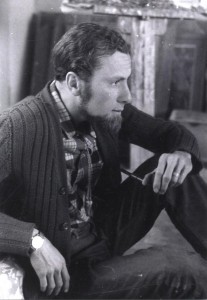 Tell me more about your Grand Canyon trips .
Well, we went down several times. We went not only when he was a fire lookout, but before that, when we hiked the Nankoweep Trail. But when he was at the tower, we went down the Thunder River trail and it was a bad time…with the deaths. We spent a couple of days and sat down there and sat in this cave, right by Thunder River and just literally wept on each other’s shoulder. It was a bad time. Was it that time? It might have been, either that time or the Nankoweep Trip that we vowed that we would paint and write the Southwest. It was cathartic going down, it was bloody hot and the place was full of rattlesnakes. So it was like a cleansing.
And I was painting during that time. Some of my best work came out of that period in Moab. I don’t know how the hell we kept working.
How do you do that? You were very prolific at that time.
I don’t know, it beats me. Anger, angst. I think we fed on anger and angst. Of course we were married to nothing but self-pity. Huge chunks of time of just self pity. I remember one time, when Ed came up to the San Juan islands to visit me and he was on one of those Alaska journeys. He was in one of those periods of self-pity, moaning and pissing all over the place. Spent the whole time with me moaning and pissing. I wrote him a letter after I got back to, it must have been Tucson then. And I wrote him and said, “For Chrissake Abbey, stop feeling sorry for yourself and write. That’s what you’re made for——to write. Stop this self pity and go back to work.” He wouldn’t speak to me for a year, he was so pissed off and then in the end he said, “You were right.”
What about your time in Utah?
I had about ten acres near Devil’s Canyon in Monticello and Ed had just broken up with Renee. He was in sad shape and I had a good wife then; Ed liked Tina, he was delighted that I had found a wife who wasn’t a Marxist revolutionary, after a series of damn revolutionaries, who were trying to make me into a Marxist. Anyway, his wife left him.. He hung out with me there. He was camping for over a month after the breakup. He was in bad shape.
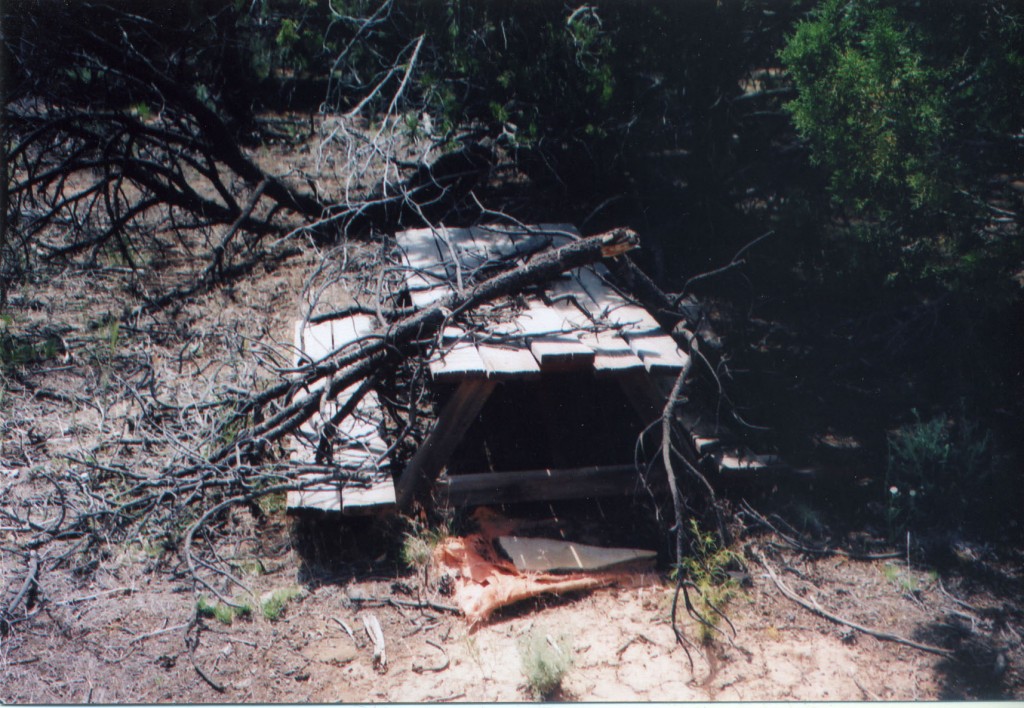
But I enjoyed my time at Devil’s Canyon, I enjoyed it. I had a half a dozen Mormon friends. No one could understand it, but I enjoyed them—some of them, not all of them. There was an old lady there, she was in her eighties, she was a direct descendant of Brigham Young among the hundreds of his descendants he had and she was kind of the primo lady.
She was a Mormon all her life, but a feminist, she wanted to reconstruct it. She said the best thing that happened in the Mormon Church was when Brigham created the United Order. It was socialist, communal ownership of the land, a socialist experiment and she said that years later, they sold him out. The church sold out Brigham by becoming capitalistic.. In those days, she said it was communal—Bluff, of course Monticello and in those days St. George. Brigham wanted to establish a non-capitalistic society with small businesses, farmers. The church changed after he died, they became big-time capitalists and they screwed him…at least that’s what this old lady told me. So some of these old Mormons to me were great, I enjoyed them immensely.
Speaking of socialism, tell me more about Rini Templeton., who you mentioned earlier in this conversation.
Oh, boy jeez. The statute of limitations are over. Rini’s father was one of the wealthiest men in Chicago; he founded the Templeton-Franklin Group? She rebelled against all that crap. That was some kind of big brokerage firm. Yeah. She rebelled against the whole damn thing. Her sister married Marshal Fields III. She rebelled against that. She went to Cuba, not long after the Cuban revolution and married a Cuban Commandante—Che Guevara was her best man at the wedding. She fought at the Bay of Pigs as a militia woman, on the Cuban side of course. But her husband was, in spite of being a commandante, a pig—a chauvinist male pig. She divorced him, came back to Taos and that’s where she met Abbey.
So, she went from the frying pan to the fire. Anyway, she remained a total Revolutionary. And she and Ed used to have these incredible fights over the anarchist philosophy as opposed to the Marxist. Before I met Ed on that ill-fated day in Santa Fe, Ed and Rini were lovers. So, we kept it in the family.
You were involved with Rini as well?.
Yeah, I lived with her for a good five years. She was an incredible woman, one of the most passionate women I’ve ever met and she was built like a brick shit house. It was a real profound love affair…I thought Marxism was a dead end, more government, more depression, more bureaucracy. Then of course, Ed agreed with me. I always thought the only hope for America was Jefferson Democracy. The yeoman farmer, the independent farmer.
How do you have Jeffersonian Democracy with the way it is now? You can do it for yourself…
Look at my neighbors, old Hispanic men that never gave up farming or small ranching.
But aren’t they almost like anachronisms? Are you an anachronism?
Oh, I’m definitely an anachronism.
How can 320 million people in this country go back to that kind of life?
Well, you know what my hope is 80 percent of us die out with either AIDS or the bird flu. If 80 percent of American died out, there’d be hope. We could start all over again…muerte, land of the dead…….
And yet, John DePuy, for all your pessimism about the future, your life has taken a rather optimistic turn.
Yes. It has! At 78, I have a beautiful wife who is forty years younger than me, a beautiful 16-month-old daughter who will be carrying my backpack in a few years. An enviable life far, far away from all the crap in society. We all love rattlesnakes and coyotes because they’re unpredictable. Anyway it’s a good life, I’ve got no complaints and I hope I can live another 30 years. Vaya con dios!