Skip to content


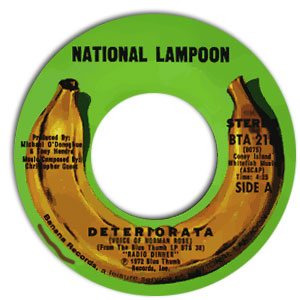
(from National Lampoon 1972) ‘DETERIORATA’ (You are a fluke of the Universe)

http://www.youtube.com/watch?v=xCGRDnTySCI


(Parody of the written prose “Desiderata” by Max Ehrmann. This was written by Christopher Guest of “Spinal Tap” fame. The narrator is Norman Rose, and the female singer was an unknown singer at the time named Melissa Manchester.)

You are a fluke of the universe. You have no right to be here.
Deteriorata. Deteriorata.

Go placidly amid the noise and waste,
And remember what comfort there may be in owning a piece thereof.
Avoid quiet and passive persons, unless you are in need of sleep.
Rotate your tires.
Speak glowingly of those greater than yourself,
And heed well their advice, even though they be turkeys.
Know what to kiss, and when.
Consider that two wrongs never make a right, but that three do.
Wherever possible, put people on hold.
Be comforted that in the face of all aridity and disillusionment,
and despite the changing fortunes of time,
There is always a big future in computer maintenance.

You are a fluke of the universe.
You have no right to be here.
And whether you can hear it or not,
The universe is laughing behind your back.

Remember The Pueblo.
Strive at all times to bend, fold, spindle, and mutilate.
Know yourself.
If you need help, call the FBI.
Exercise caution in your daily affairs,
Especially with those persons closest to you –
That lemon on your left, for instance.
Be assured that a walk through the ocean of most souls
Would scarcely get your feet wet.
Fall not in love therefore. It will stick to your face.
Gracefully surrender the things of youth: birds, clean air, tuna, Taiwan.
And let not the sands of time get in your lunch.
Hire people with hooks.
For a good time, call 606-4311. Ask for Ken.
Take heart in the bedeepening gloom
That your dog is finally getting enough cheese.
And reflect that whatever fortune may be your lot,
It could only be worse in Milwaukee.

You are a fluke of the universe.
You have no right to be here.
And whether you can hear it or not,
The universe is laughing behind your back.

Therefore, make peace with your god,
Whatever you perceive him to be – hairy thunderer, or cosmic muffin.
With all its hopes, dreams, promises, and urban renewal,
The world continues to deteriorate.
Give up!

You are a fluke of the universe.
You have no right to be here.
And whether you can hear it or not,
The universe is laughing behind your back.

You are a fluke of the universe.
You have no right to be here.
And whether you can hear it or not,
The universe is laughing behind your back.

TO READ THE CURRENT Z CLICK HERE

TO READ ALL ZBLOG POSTS CLICK HERE

Posted in Uncategorized.


Herb Ringer: “Oh…It’s from King Tut’s tomb.” (from the Zephyr archives)

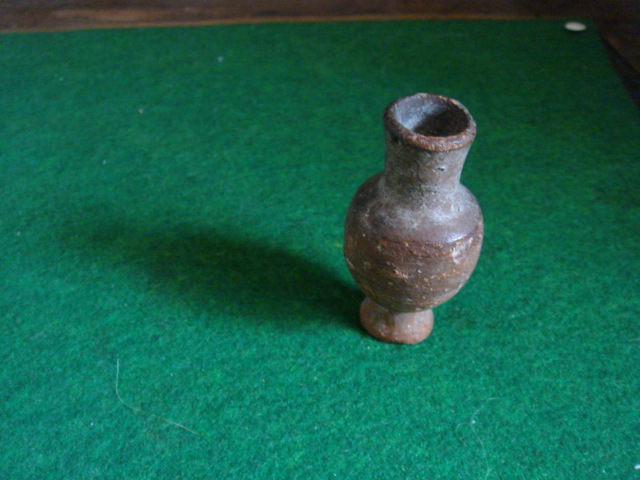
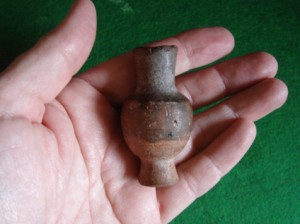
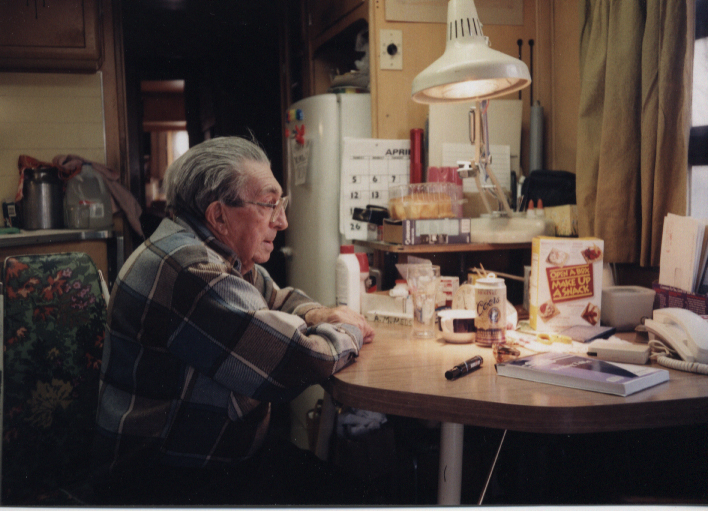
About a year before his death in December 1998, I spent some time with Herb at his home in Fallon, Nevada. He lived in a 42 foot “Smoker” house trailer that he purchased in the early 50s. One night as he regaled me with stories of the Old West, I noticed a small plastic cylinder on his kitchen table. It appeared to be stuffed with tissue, but knowing Herb, I reckoned there must be more to its contents than toilet paper.

Herb’s deteriorating eyesight made it difficult for him to see any small object so I described the small plastic container.
“Oh yes…You might as well have it. I can’t even see it anymore.”
“Well what is it?” I asked.
“It’s priceless,” Herb replied.
“Okay, Herb,” I said, “but what is it?
“Oh…It’s from King Tut’s tomb.”
This is the story Herb told me.
In the 1920s, Herb’s father Joseph Ringer played the french horn for some of the most celebrated orchestras in the country. One of Joseph’s fellow musicians traveled to Europe in the sum­mer of 1925 to play with an orchestra in Vienna.
But during a break, he took a side trip to Cairo. Tutankhamen’s tomb had been discovered the year before and locals had been hired, at pauper wages, to do most of the heavy digging. Subsequently many of the diggers concealed small artifacts in their clothing and sold them on the streets of the city. Herb’s friend purchased the small vessel and returned to the United States at the end of the summer, he gave the artifact to Herb for his 10th birthday.
Is it really from King Tut’s tomb. I’ve never found out.
I know it’s at least 85 years old and that it was one of Herb Ringer’s treasures. That’s enough for me…JS
The Dec/Jan issue is online (click the cover)

Posted in Uncategorized.


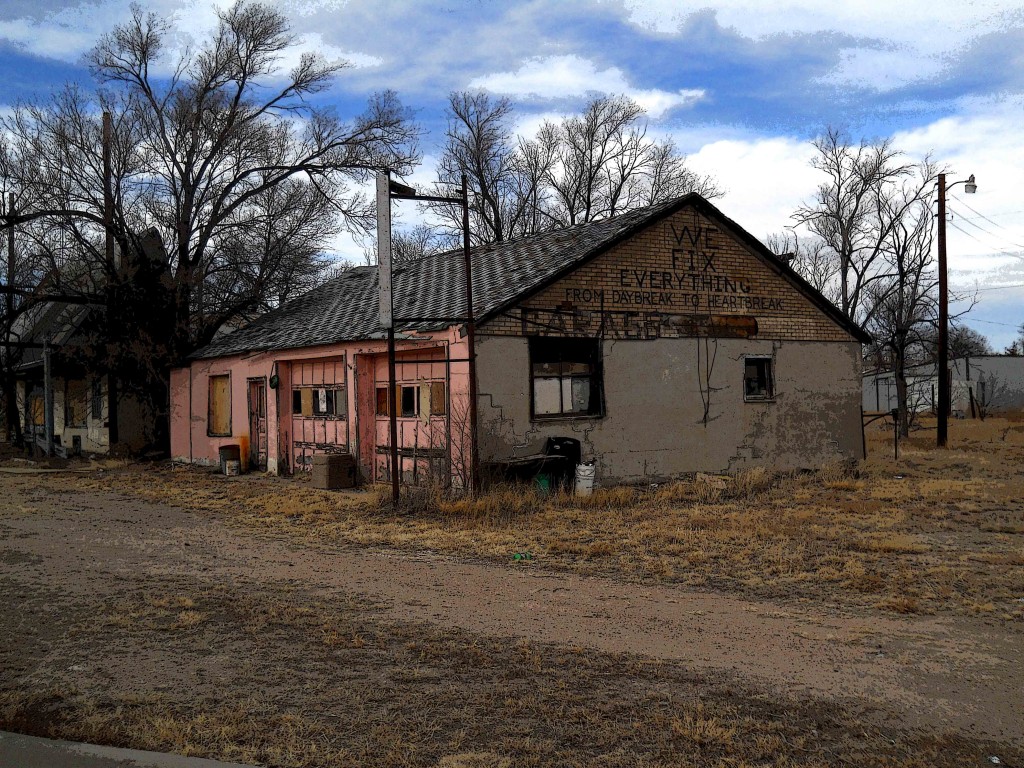
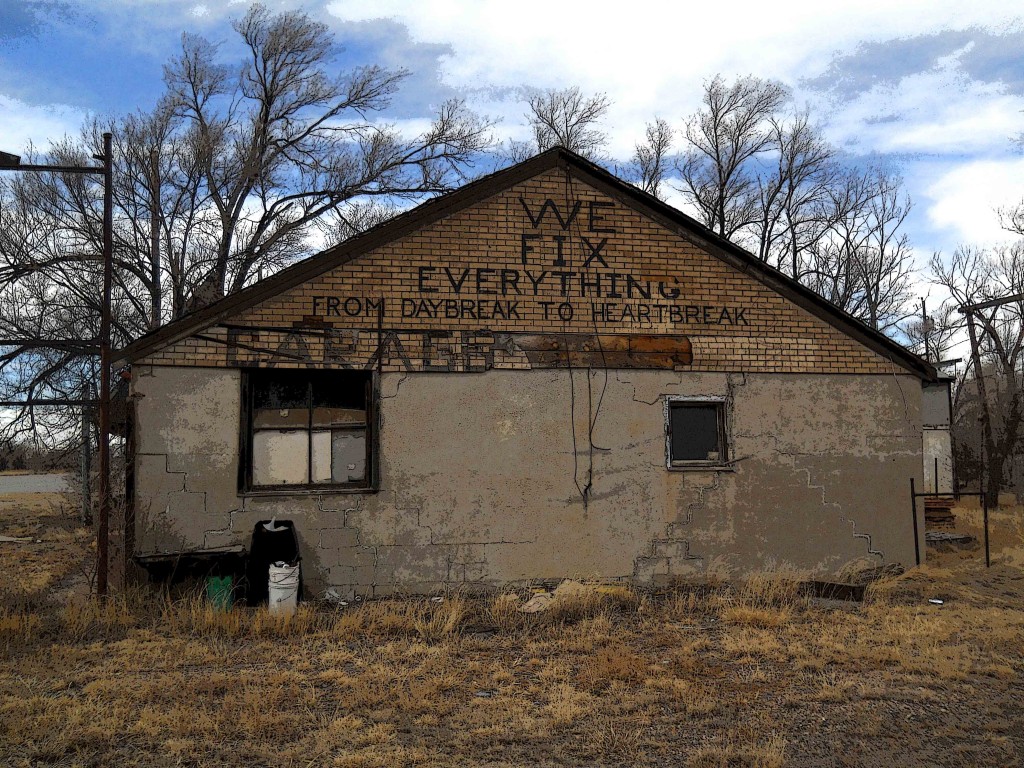
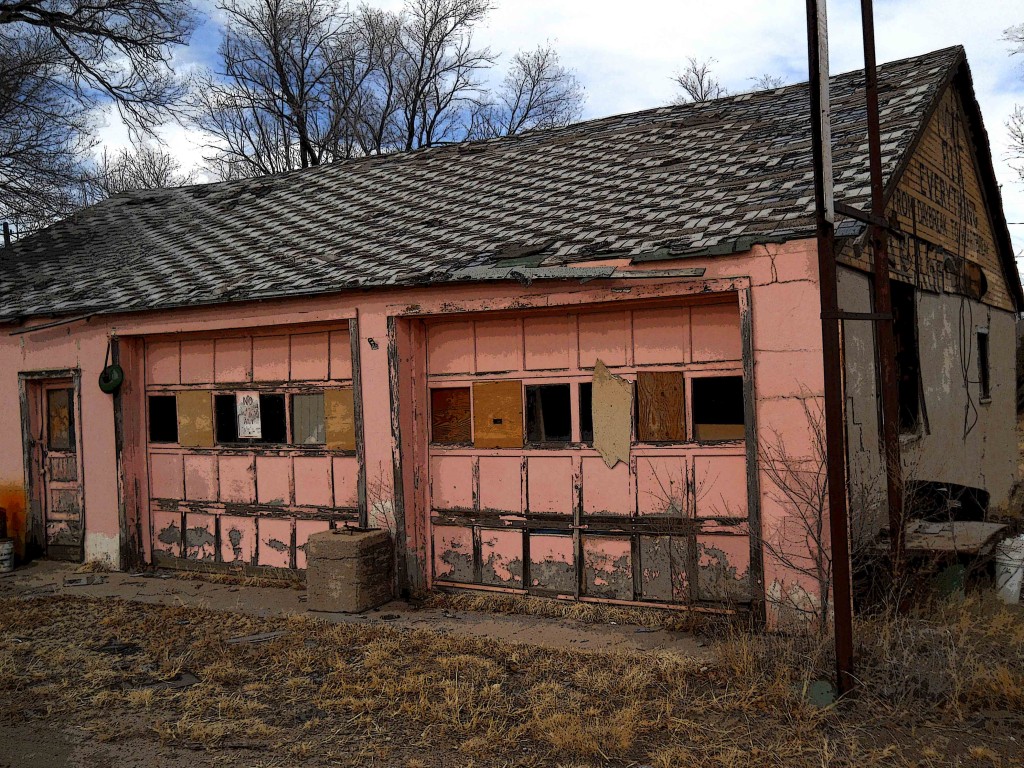
Poking Through the Ruins #11— “WE FIX EVERYTHING—FROM DAYBREAK to HEARTBREAK”

“WE FIX EVERYTHING…From Daybreak to Heartbreak”…..somewhere in Colorado.


The Dec/Jan Issue (click the cover)

Posted in Uncategorized.

Tagged with .


(from the archives) ‘ARCHES STORIES— from Denis Julien to the Arch Hunters’

The National Park Service is in the process of expanding the Arches National Park visitor center, five miles north of Moab. When it was built in the early 1960s, fewer than 75,000 tourists came to the park annually. Four decades later, that number seems almost quaint as visitation pushes toward one million. The park roads are often crowded to the point of gridlock and the trailheads are full. Even on the trails themselves, it’s rare to be out of sight of other hikers.

It wasn’t always like this.

For centuries, for millennia in fact, the stone monuments were unknown, unnamed, and unseen by anyone but the critters that lived there, undisturbed in the shadows of the big rocks. That began to change ever so slightly, about 2000 years ago, when Anasazi indians first wandered into the canyons and mesas and ridges— to places that would only be assigned “official” names thousands of years later. Their impact on the park came in the form of etched images on the sandstone and the “lithic scatter” of chert left behind by toolmakers of that time. Over the centuries the Anasazi came and left. Utes wandered into the Arches Country in the 17th Century. White men didn’t leave their mark at Arches until the mid-19th Century. And even into the middle of the 20th Century, a relative handful of people found their way to the spectacular arches and windows.
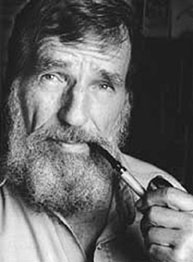
If you could tally the total human visitation since the beginning, going back at least 2000 years, 99.9% of them would have arrived since 1958, when the Arches entrance road was paved. Of all the visitors who have come to Arches, some have been memorable enough to still be remembered. A few of the names are well-known—we all know Ed Abbey wrote Desert Solitaire while working as a seasonal ranger at what was then Arches National Monument in the mid-1950s. Bates Wilson was the first superintendent of Arches National Monument and later became known as the “Father of the Canyonlands” for his efforts to preserve the vast canyon country west of Arches. Trivia buffs know that parts of “Thelma and Louise” were shot in the park.

But there are other people, more obscure, but just as interesting, whose stories deserve to be heard. Here are a few of them….

THE NEWLYWEDS…

Not much is known of the Native Americans who passed through the Arches Country a thousand years ago. Because the park has a limited number of permanent water sources, many archaeologists believe that the area was used more as a hunting ground than as a place to live. There are few structures in the park (I know of three and I’m not talking). But along many ledges and under shady overhangs, evidence of their presence, in the form of lithic scatter–broken pieces of chert that were discarded as they fashioned projectile points, is common.

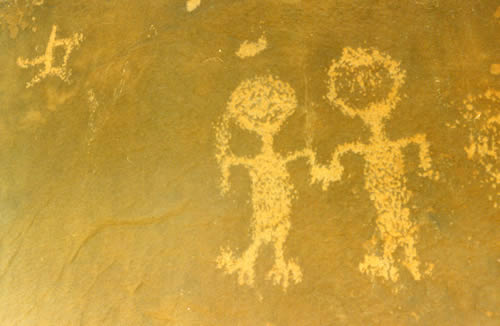
In a few remote locations, the Anasazi left their artistic talents on the sandstone. One in particular, always caught my eye. High on a canyon wall, overlooking the modern highway is this image. I would almost swear that one of them is smiling. We used to called them “The Newlyweds.”


DENIS JULIEN…JUST PASSING THROUGH

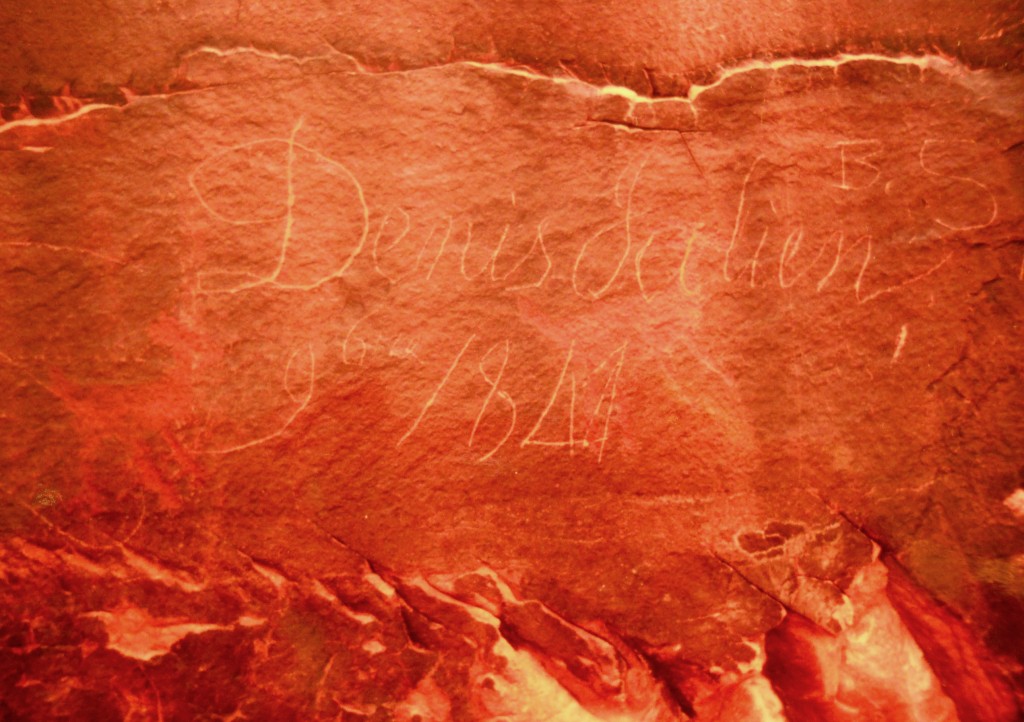
For a century, river runners on the Green and Colorado Rivers had seen the bold inscriptions of “D. Julien.” Little was known of Julien but it was assumed he was a fur trapper of French origin and that he had spent time during the 1830s in the Colorado River basin. But no one could ever find a Julien graffiti any later than 1837. There was speculation among historians that Julien’s disappearance suggested he had in fact drowned in the Green River. It was as if he vanished around 1837.

Then I came along and screwed up the historical record. One day in the late 1970s, while a seasonal ranger on backcountry patrol at Arches, I spotted some sheepherder inscriptions on a desert varnished wall. Sheepherder graffiti from the 1920s and 1930s is common and I was hoping to find yet another “Dominguez” inscription, a frequent visitor to the Arches Country. There, among the 20th Century carvings, another inscription jumped out at me. In a very unique cursive script, the name “Denis Julien” practically jumped off the wall. Beneath it was a date. I could not read the day or month, but I could definitely make out the year—1844. I was aware of the other Julien inscriptions and thought this might be significant. I told the chief ranger the next days and within a week, I was escorting crazed historian John Hoffman, who had flown in from San Diego, to the site. Hoffman recognized its authenticity immediately. “Way to go, Stiles…you just brought Denis Julien back from the dead.”

I’ve gone back to the site a few times and am always reminded of one seldom remembered fact–when Julien carved his name, he did it right over the top of an Anasazi petroglyph. He may be the first white man in history to vandalize a prehistoric rock art site.
 

HANK SCHMIDT…THE GREAT ‘REPORT WRITER.’

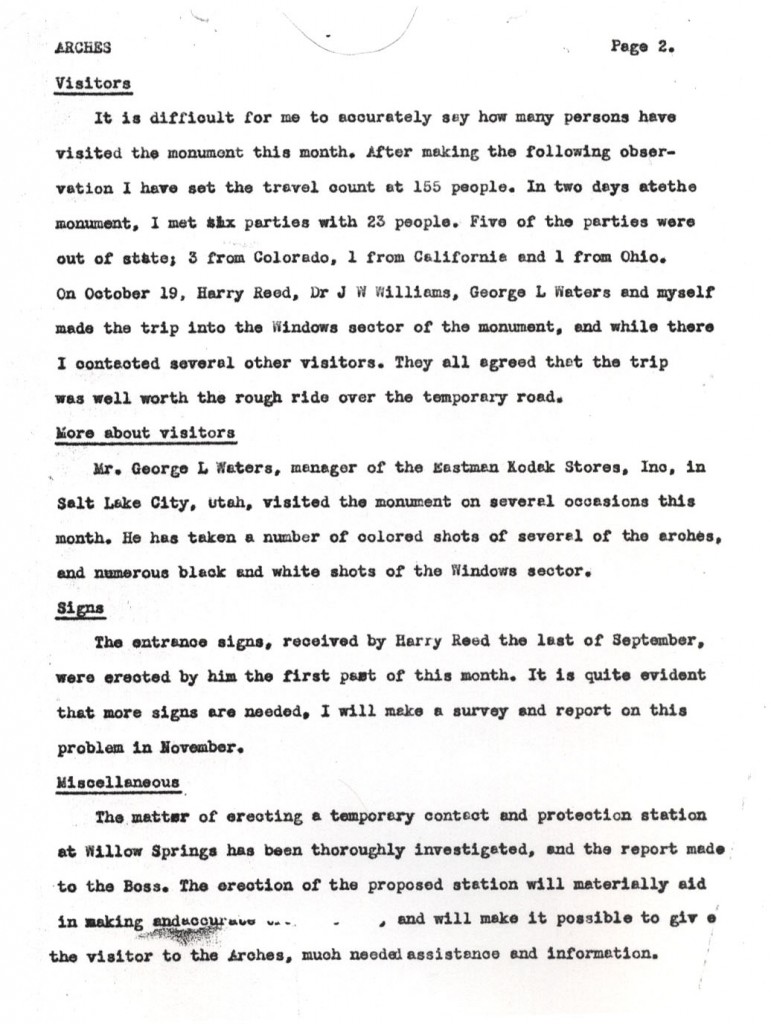
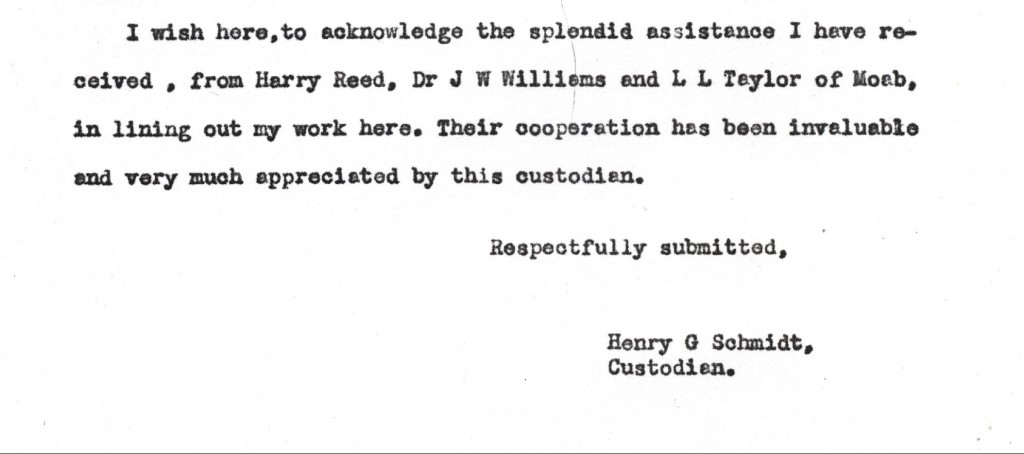
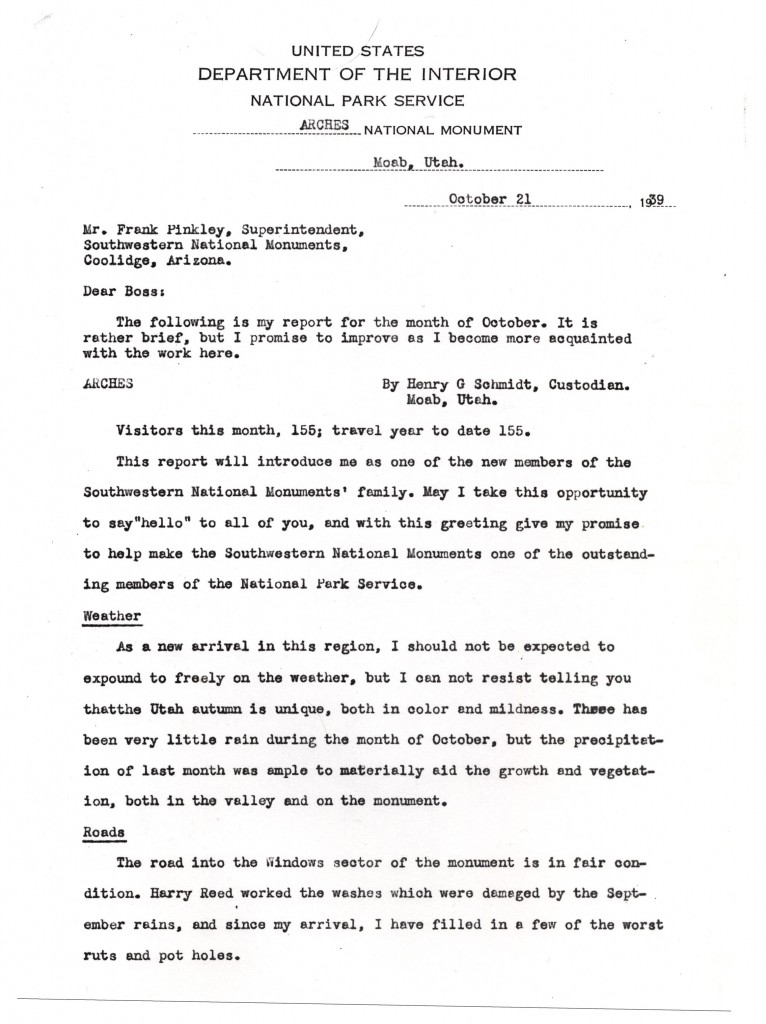
More than fifteen years before Abbey’s arrival, Hank Schmidt assumed his duties as Custodian at Arches National Monument and began recording his impressions on a typewriter. From 1939 to 1941, Hank Schmidt wrote monthly reports to his superintendent, Frank “Boss” Pinkley in Arizona. Schmidt’s folksy conversational reports are still entertaining after all these years.

Here are some excerpts…
THE FIRST FATALITY AT ARCHES…

Freddie Semisch seemed to be cursed with bad luck, from a very early age. He was born in Chicago in 1930 to German-born parents. His mother and father, Anna and Carl, had not yet become naturalized U.S. citizens, however, and in 1939 the Semisch family decided to visit Anna’s mother in their German homeland. They had intended to stay only three months, but when war broke out, the Semisches were prohibited from leaving. They spent the entire war there. In 1946, Freddie, now 16, was allowed to return to the U.S., though his parents were detained for another six years.

Semisch lived in New York where he worked as a watch repair man. In 1950, he planned a cross-country trip with his friend Gilman Ordway. Their destination was California but the long road brought them through Colorado to Utah, to the seldom visited Arches National Monument.

On the morning of May 29, 1950, Semisch and Ordway made their way down a rough sandy road to the Devils Garden. They bogged down in the sand at least once; a photographer from California, Stanley Midgeley pulled them out; they arrived at the trailhead at about the same time and all of them hiked north about a mile to Landscape Arch.

Semisch, the more reckless of the two, proposed to Ordway that they climb the arch. To reach Landscape Arch, a hiker needs to go north more than half a mile and ascend the sandstone fin that abuts the arch. This is fairly easy and while the walk along the ridge of the fin is precarious in places, it must have seemed a cake walk for the athletic 20 year old. But the fin runs out, just north of Landscape Arch and from there, you need a good rope or wings—Semisch had neither. But the friction support that the coarse sandstone provides must have convinced Semisch that enough traction was there to inch his way down the abutment to the end of the span.

He was wrong.
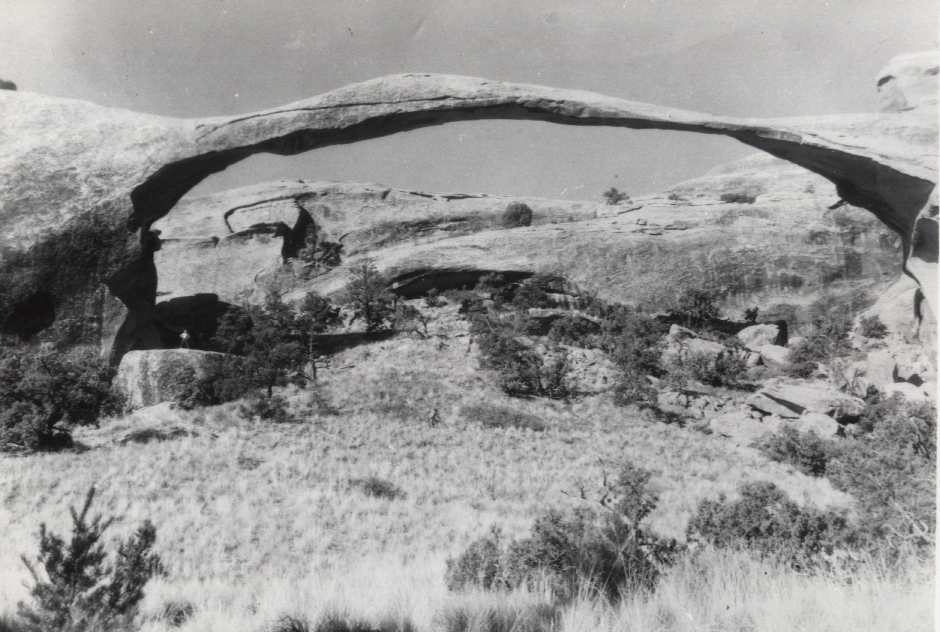
LANDSCAPE ARCH in the mid-1950s. Notice the figure at the far left side of the photo.

By now, photographer Midgely had positioned himself and his camera below the arch and could see and hear Semisch, calling from above. Midgely turned to adjust his camera and in the next moment, heard Semisch scream. He looked back to see Freddie sliding down the abutment to the arch, fighting furiously to slow his descent. But the fall was too far and too steep–he hit the narrow shelf at the base of the abutment, his last hope to survive, but could not hold on. He bounced once and went over the side. He fell more than 200 feet.

Midgely was the first to reach Semisch’s body. It had rolled another 150 feet after his free fall, into a narrow chute north of the arch. Freddie Semisch was dead upon impact. Ironically, his friend Ordway had walked north from the arch, had not heard Freddie’s screams and did not know of his friend’s death for more than 15 minutes.

Other witnesses drove toward park headquarters and encountered park maintenance man Merle Winbourn who informed Superintendent Bates Wilson of the death. Bates arrived a few hours later, with Sheriff J.B. Skewes and two deputies. They recovered the body and hauled Semisch out on horseback to a waiting truck at the trailhead.

His parents, still in Germany and unable to leave, could only grieve for their son from the other side of the world. His body was held at a funeral home in Price, Utah until relatives could claim the body. But an uncle and aunt living in the U.S. chose not to. And so on June 5, 1950, a graveside service was held for Freddie Semisch who was buried in an unmarked grave. Ten years later, his parents were able to provide a headstone for his final resting place.

THE ARCH HUNTERS

They came from the four corners of the continent—from Northern Utah and the Rocky New England coast. From the Jersey Shore and the Texas plains. Four pilgrims pursuing a dream. They found it right here.

Doug Travers. Dale Stevens. Ed McCarrick. Reuben Scolnik—we called them “The Arch Hunters.”
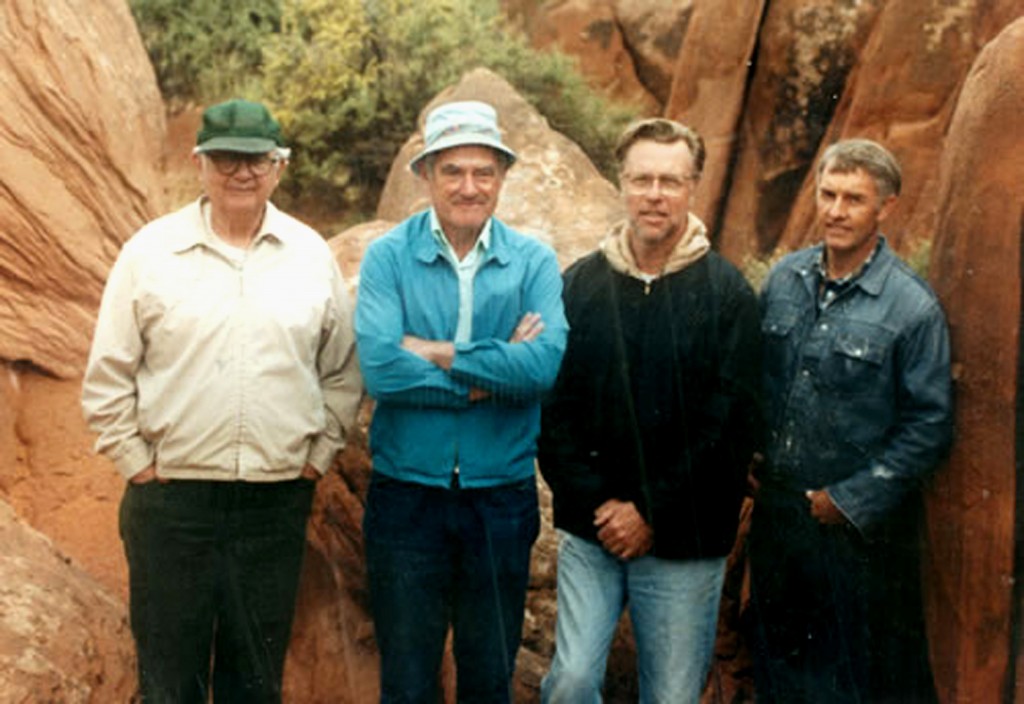
THE ORIGINAL ARCH HUNTERS: Ed McCarrick, Reuben Scolnik, Doug Travers, Dale Stevens.

For reasons that I have never been able to fully grasp. Some men are destined to search for holes in the rock. I don’t know if this is some kind of affliction—with all the New Disorders facing American Society, I’m sure it’s only a matter of time until arch hunting is diagnosed, given a name and a treatment is developed—but certainly, something happens to some men when they come to Arches National Park (note: I do not mean to exclude women–I simply don’t see this illness affecting the female gender).

The first of the Arch Hunters to find his way to Moab was electrical engineer Doug Travers of San Antonio, Texas. With his sons, Jay and David, the Travers men became transfixed by the strange desert landscape. Their first visit in 1965 was all too short and they vowed to return. The Travers men kept their promise, along with the younger Travers boys, Rod and Roy, and returned dozens of times over the next 35 years.

Ed McCarrick retired from Western Electric in Hoboken, New Jersey in the mid-70s and moved to Moab. In 1976, at age 55, Ed became a seasonal ranger at Arches National Park. McCarrick worked the entrance station for years and in the late 70s often called me on the park radio for campground conditions. In his distinctive New Jersey squawk, Ed would key his mike and say, “Hey 236, this is 231…what the hell is going on up there? I need a campground count. These damn tourists are pouring in like flies.”

And Ed is the only government employee I’m aware of who ever referred to a young woman as a “tomato” on the FCC-approved government band. “Yeah, Jim…a real tomato just came through the gate…she’s driving a Ford Pinto.”

“Uh…10-4, Ed”

In 1973, professor Dale Stevens of Brigham Young University gave a certain credibility to arch hunting as a career move. With a group of students from BYU, Dale conducted a field survey of arches within the park “as part of a larger study of the geomorphic importance of arches and bridges in southern Utah.” He located 124 natural rock openings, 90 of which he identified as arches. Stevens also provided substantial data on criteria for determining types and measurements. Later, the study came to be known as “The Stevens List.” It was pinned to a closet door in the chief ranger’s office where it rarely received more than a cursory glance, until one day the fourth of the soon-to-be Arch Hunters entered our visitor center and shamed us all into giving it a closer look.

His name was Reuben Scolnik. He was a retired aeronautical engineer from NASA, looking for a project to occupy his summer. In 1977, he thought he might spend a few weeks looking for arches and inquired about a list. We gave him the Stevens List and hoped he wouldn’t ask any questions…he did.

It would go like this.

“Ranger Stiles, I was in the Devils Garden today and I have a problem with arch #91. Have you noticed that Stevens has placed that arch in the wrong canyon?”

“Uh…yes Reuben. I’d heard that.”

“And I have a problem with its categorization. Do you really consider that a ‘cliff wall’ arch?”

“Well….I…uh.”

“You do know where #91 is?”

“Sort of…”

“Have you been to 91?”

“Not exactly.”

“What exactly DO you do here in the park?”

Humiliated beyond words Chief Ranger Jerry Epperson called the rangers together to discuss our inadequacies. Eventually, he established the need and implemented an arch inventory—a systematic exploration of the park and a running record of all rock openings greater than three feet (an arch criteria established by Stevens).

I thought it was a great idea. It meant I’d get to spend two or three days a week, getting paid (albeit a pittance) to wander the park’s most isolated backcountry, in search of holes. Often accompanied by the Arch Hunters, we explored every side canyon, every fin, every remote cluster of sandstone pinnacles for the elusive windows in stone. But the windows weren’t as elusive as we thought they’d be. The three foot arches were everywhere.

Reuben and I became bored with the little holes. Ed became obsessed with them. In fact, Reuben and I were convinced that Ed McCarrick had gone mad. Here’s Ed with a tape measure, taking stock of tiny little hole..

“What does the tape measure say, Ed?”

“Well…hold on Stiles. It says 34 inches. But wait a minute..this..dirt is in the way.”

So there’s McCarrick trying to dig ‘dirt’ out of the buttress of the arch with his fingers.

“Is that legal, Ed?”

“Sure it is…there. See? It’s 37 inches after all…write it up.”

Travers, who had always taken a low-key approach to arch hunting, finally met Reuben and Ed in the early 80s. The three compared lists, and whenever Doug was in town the Three Archqueteers sallied forth into the desert sun in search of the golden arches. More often than not, the quest ended in a brouhaha. Reuben and Ed, in particular, failed to agree most of the time.

“Ed,” says Reuben. “This is not an arch. This is a piece of exfoliated sandstone.”

“What are you talking about?” exclaims Ed. “It meets the criteria!”

“I don’t care. It is NOT an arch!”

“It IS!!!”

Reuben walks to the disputed “arch” and stands on it.

“There!” Reuben growls. “Now it’s NOTHING!”

“Now, now, gentlemen,” interjects Travers the Reasonable One. “Remember…I’m videotaping everything.”

The debate never ended. Stevens later reaffirmed his assertion that an arch was any rock opening larger than 36 inches, McCarrick went nuts. The numbers grew to 2000…3000 and beyond. Scolnik abandoned arches altogether and started looking for rock art sites in Death Valley but could never get ‘arches’ out of his system. Years later, out of the clear blue, he’d call me and ask questions like, “Remember that arch near Herdina Park where I found the Dutch oven?” I didn’t, but he did.

Travers continued his semi-annual trips and still finds a new arch or two, every time he visits.. Stevens and McCarrick eventually pooled their arch knowledge, experience, energy and love of arches, and produced the definitive book about rock openings–”The Arches of Arches National Park: A Comprehensive Study.” Sadly, Ed died of cancer in 1993 and a year later, Dale was killed in a motorcycle accident in Provo. After all these years, we still miss them.

In one realm or another, the Arch Hunters carry on.

DESERT BIGHORN: 1 TOURIST: 0

We don’t know his name. We don’t have any photographs. It’s only hearsay.

But we hope it’s true.

A tourist sees a small herd of desert bighorn sheep near US Highway 191, a couple miles south of the entrance to Arches National Park. The sheep are clustered about 100 feet from the highway, minding their own business, but the tourist, a man in his 40s, perhaps of European descent, wants a photograph. So he climbs out of his car and moves toward the sheep. The sheep eye him warily. Soon most of them are clattering over the rock, moving away from the man and his zoom lens. The man is still walking toward the sheep, his eye glued to the viewfinder. Suddenly he realizes he has a great shot…if only the sheep would hold still. Looks like a ram. The sheep is almost too close. The ram IS too close.

In the next moment, the hapless tourist and his zoom lens experience weightlessness. The ram butts the shutterbug head-on and lifts him into the air. Dazed and confused, he starts to get up. The ram hits him again. Now the man is crawling along the ground, his camera dragging though the sage and the sand. The ram cracks him in the ass.

His friends sit paralyzed in the car, unable to help. He finally screams, “Open the goddamn door!” He reaches the car, bleeding and in shock, his companions lift him into the back seat and the ram pauses to admire his work. They slam the door, the driver turns the ignition and, in a spray of gravel and dust races away in the direction of Interstate 70, Denver and a long flight back to Europe. He was never seen or heard from again.

From all this, naturalists have determined that Desert Bighorn rams are camera shy.

THE BEAR THAT CAME TO ARCHES…

Most of us think of the high country when considering bear habitat. But have bears ever visited the red rocks at Arches? It happened once that I know of.

In the late 1970s a European tourist notified rangers at the Visitor Center that he had seen a black bear in the vicinity of South Window, east of Balanced Rock. Chief Ranger Epperson tried to shake his story, convinced the man had seen a very big dog. But the European was adamant, so Epperson called me by radio to look for a bear.

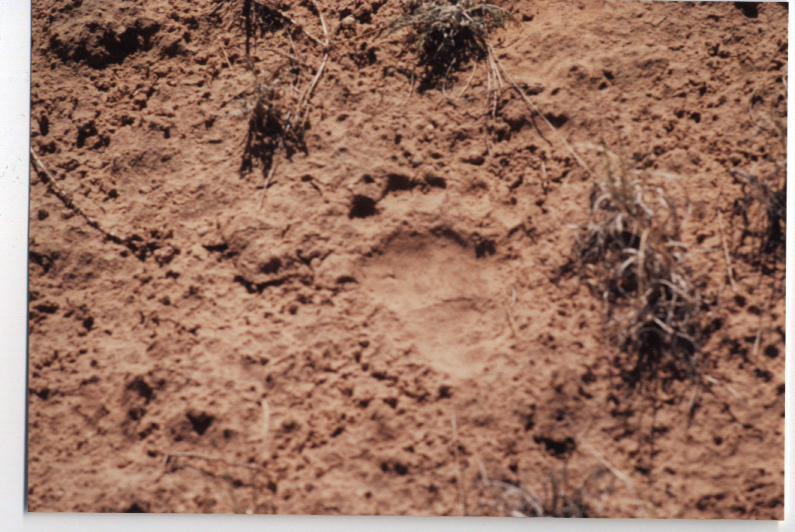
I was always happy to escape campground duty and set out to find the phantom bear. I never saw the bear but, surprisingly, I found the unmistakable print of fresh tracks. The bear was headed into the drainage of Courthouse Wash. Where he came from, or where he was going, we’ll never know.

But I took this photo, the only evidence of a bear at Arches.
Posted in Uncategorized.


ABBEY UNVARNISHED…on ‘moral courage.’

“Any fool and coward can rail away at foreign enemies; moral courage implies the willingness to risk attacking those who call themselves our friends, protectors, lords, etc…”

letter to John Gardner, 4/5/82

Posted in Uncategorized.

Tagged with , , , .


‘IT’S TIME (AGAIN!) FOR M.A.H.B.U: Mormons & Heathens for a Better Utah’ –Jim Stiles (from the 2004 archives)

EDITOR’S NOTE:  I wrote this almost a decade ago..not much has changed. If anything the polarization is worse. Is it time for MAHBU again???  JS

I am terminally sick of hypocrisy. My own and everyone else’s.

I don’t care which direction the entrenched ideological contradictions are coming from–left or right, above or below–I long for honesty and all things genuine and sincere, even if they are wrong-headed. If you’re wrong-headed, or I am, then let’s be truthful about it. That’s the beauty of honesty. Boneheads talking to boneheads can reduce bone mass. As a self-confessed bonehead, I’m searching for a different and better way to reduce the thickness of my own skull, as well as yours.

I admit, Life was much easier when I viewed the world through a black & white lens. And easier is the critical word to note here; it’s much easier to condemn everyone else’s perspective when we’re unwilling to honestly scrutinize our own. And it is easier to attack our adversaries when we don’t know them. I have agonized over this for years now. I have shared my feelings with my friends and with strangers. Those feelings have been met in a variety of ways–blank stares, outrage, ridicule, silence and sometimes…sometimes with the look of a shared epiphany. “YES…I know exactly what you mean!” As if someone with a secret had just found a kindred spirit.

Those moments have given me some comfort. Not much, but a little.

And so, it is truly, at long last, perhaps in the nick of time, and perhaps too late to nick anything…it is time for M.A.H.B.U.

Mormons & Heathens for a Better Utah.

First, about the name. Not everyone on one side of the mythical ideological fence is a member of the LDS Church. Not all people on the opposite side are heathens. I was looking for an acronym, to begin with, and one that might best suit Utahns. When I stumbled upon MAHBU it sounded as if I’d morphed Nauvoo, the site of the original Mormon temple in Illinois, with SUWA, Utah’s most prominent environmental group–surely a frightening prospect for everyone involved regardless of their affiliation. But then, that’s the point. To force everyone to be uncomfortable with their proximity to each other, instead of exchanging pot shots from the relative safety of across the fence.


At the heart of this war in the American West—and that’s what we should call it—is a fundamental conflict of cultures over the future of its landscape. The vast majority of Americans who call themselves environmentalists, 78% in one survey, live in urban areas. They are the “New Westerners.” Their connection to the land is mostly as observers, recreationists, and infrequent visitors. Most of those who oppose the environmental movement actually live and work in the small rural communities of the West and many of them make their living from the land itself. They still represent the Old West. For the urban enviros, there’s the rub.

What has ensued in the last three decades has been increasingly painful to watch. Each side of the conflict has so savagely misrepresented the other, so excessively caricatured their opponents, that they have, in the process, turned themselves into pretty laughable cartoon characters as well. There is nothing like bloated self-righteousness to make anyone seem ridiculous; to me everybody looks goofy these days.

So what are the contentious issues driving this debate. Basically it’s this: Rural Americans live in small towns and the core of their economies is extractive–ranching, mining, timber. To deny that the extractive industries have wreaked stunning and long-term destruction upon the Western landscape and its ecology is absurd.

Urban Americans want to eliminate these industries, or at least curtail them to a large extent. They believe that another kind of economy, what environmentalists have called the “amenities economy”—tourism mostly in all its forms— is a clean and viable alternative to mining and ranching and timber. They are convinced it can allow the rural West to prosper and prevail, without further degradation to the resource. To deny that this kind of transformation of the rural West has bleak and destructive consequences of its own is equally absurd. The amenities economy is just another extractive industry and should be regarded by environmentalists with the same concern. But they don’t.

And so it’s a standoff. Nobody wants to be honest for 30 minutes. And that is why MAHBU must step into the wide and yawning breach of credibility. We are about to be painfully honest. Let us begin…NOW:
Most Old Westerners oppose wilderness, since they believe it will limit their access to public lands. Sometimes their physical abuse of the land itself is dramatic and the damage is long-term. On the other hand, Old Westerners understand one key component of wilderness far better than their adversaries. They understand solitude. Quiet. Serenity. The emptiness of the rural West. They like the emptiness.


New Westerners are individually more sensitive to the resource but are terrified of solitude. They’ll walk around cryptobiotic crust but leave most of them alone in the canyons without a cell phone and a group of companions and they’d be lost, both physically and metaphysically. And since they need to travel in packs, the collective resource damage is far more than they might realize.

Old Westerners like their jeeps and their ATVs. Among these thousands of motorized recreationists are a minority of reckless and thoughtless idiots who cause a disproportionate share of the resource damage. Many of their peers know this and don’t like it, but don’t apply peer pressure because the one thing they’d rather NOT do is be seen agreeing with an environmentalist.

New Westerners drive hundreds or thousands of miles in gas-consuming vehicles so they can pedal their bicycles for ten and say they’re non-motorized recreationists. Bicyclists gather for rallies and races just like their motorized cousins and cause extraordinary damage when the numbers are high enough; yet environmentalists refuse to acknowledge that many, many bicycles can sometimes cause as much damage as ATVs.

Old Westerners like cows. Millions of cattle still graze on public lands and some ranchers who hold federal grazing allotments are terrible stewards of that land. They allow overgrazing, destroy valuable and rare riparian habitat and turn some public lands into barren wastelands.

New Westerners hate cows. They think all ranchers are bad stewards. They want to eliminate all public lands grazing. But when they buy a condo in a New West town, they love the view of the adjacent alfalfa field from their picture window and complain bitterly when yet another development wipes out the pastoral scene.

Cows eat alfalfa.

A few Old Westerners like to hunt. Mostly deer and elk. Each year a few hundred hunters in Utah get a permit to kill a cougar. They chase the big cat with their dogs, run it up a tree and shoot it. Sounds pretty barbaric to me.

Most New Westerners hate to hunt. And they would never kill a cougar. But when thousands of cougar-loving recreationists invade once empty public lands that are habitat for wild animals (like cougars, deer and elk), it is a hunt of sorts already–a hunt to eliminate the habitat that wild and reclusive animals like cougars need. Conflict is inevitable. Two mountain bikers were attacked and killed recently by a cougar in wilderness near San Diego. The cougar was promptly tracked down and shot by the authorities because the animal had become “a problem.” No objections were heard by New Westerners this time. New Westerners build their homes farther into wildlands, so they can “live amidst Nature,” but when a bear pinches off the head of a favorite French poodle, retribution is acceptable.

Most New Westerners long for the simple life and want to move to a small town. But they hold the Old Westerners in low esteem and abhor their politics. And when they move to a small town, they build an oversized home, complain about the lack of amenities and try to change everything.

Most Old Westerners actually live the more modest and simple lifestyle that their New West adversaries claim to admire. Their homes are smaller and their cars are older. They recycle their junk (or at least don’t throw it away) and generally do without a lot of luxuries that a New Westerner could never endure. They despise the smug arrogance and urban ways of their new New West neighbors. But if they had more money they would probably live just as extravagantly.

New Westerners claim that the uncontrolled growth of the “amenities economy” is out of their hands, that market forces and the whims of American Culture are driving the New West, not them. As one Utah environmentalist said defensively, “It would have happened anyway.” In effect they now refuse to take ‘credit’ (or responsibility)  for the extraordinary “success” of the very economy they claimed would save the West. They actually distance themselves from the “solution” they continue to promote. Every new convenience store, every condo development, every golf course, every four star restaurant in a town with a population of 5000, even every ATV rally is an extension of the “amenities economy.”

Old Westerners long for the “good old days” of ranching and mining, detest the tourists and the New West image of their towns, but never hesitate to make a buck from the “amenities economy” when the opportunity presents itself. Many Old Westerners are millionaires today because land they bought for next to nothing in the 60s or 70s is now worth a fortune.

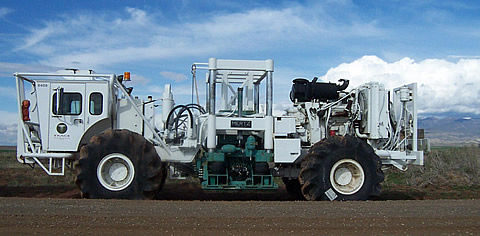
Old Westerners love seismic exploration work. It brings money to the rural economy. But it also leaves a swath of destruction in its path. While restrictions have reduced the amount of damage that seismic work once caused, its effects can still be seen years later. But once the work is done, the land returns to “normal” as far as the habitat goes. Wildlife is most adversely affected by constant human intrusions. The one good aspect of a seismic crew is that when they complete their work, they leave.

New Westerners hate seismic exploration. They often hold on-site protests and to some animals, their long-term presence is more offensive than the thumper trucks. The fact that desert bighorns have vanished from the Gemini Bridges area near Moab is not because of the seismic work that environmentalists fought in the early 90s; it’s from recreationists, both motorized and non-motorized, that have driven them into hiding. And, of course, many seismic trails never get a chance to recover because bicyclists and ATVs keep using them.

Old Westerners are unlikely to go backpacking or exploring for the sheer pleasure of it. Many of them would think such an effort to be pure folly. Sometimes they seem oblivious to the Beauty that surrounds them. But if they broke down or got stranded in the backcountry, they would probably be able to take care of themselves, because most of them have lived close to the land all their lives.

New Westerners love to go backpacking and exploring, but many of them, urban dwellers mostly, simply don’t have the skills necessary to survive, if something were to go wrong. As a result, the search and rescue budgets of many rural Western communities have increased astronomically in recent years. Most members of Search & Rescue teams are Old Westerners.

Old Westerner advocates insist increased production is absolutely necessary to reduce our dependence on foreign oil. Many of those same people mock efforts to reduce U.S. dependence through conservation efforts, which is really stupid. Why would conservatives oppose conservation? Because they’re afraid to be linked with anything remotely supporting an “environmentalist” perspective.

New Westerners oppose increased oil and gas exploration and advocate conservation efforts; yet most of them are bigger consumers of natural resources than the people who defend drilling in the public domain. And while they decry the loss of wildlife habitat, the fact is, most wildlife adapts quite well to inanimate objects, including oil wells. It’s constant human intrusions that can critically disrupt their lives.

Most Old Westerners love the owners and major stockholders and corporate heads of oil and gas companies who are mostly rich, arrogant bastards and personal friends of the Vice President. Most field employees of oil and gas companies are hard-working middle-class Old Westerners, trying to keep food on the table.

Most New Westerners despise the owners and stockholders and corporate heads, not to mention the vice president. But they also detest the field employees, which is about as wrong-headed as the Old Westerners’ admiration of Dick Cheney.

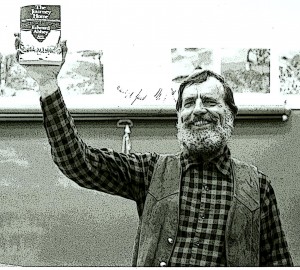
Most Old Westerners hate Ed Abbey, who once said, ” If America could be, once again, a nation of self-reliant farmers, craftsmen, hunters, ranchers and artists, then the rich would have little power to dominate others. Neither to serve nor to rule. That was the American Dream.” Despite such sentiments, they still despise him, and they stubbornly refuse to read his books.

Most New Westerners love Ed Abbey, even though they despise half of the people Ed honored in the preceding quote. They’ve read all his books and possess cherished signed copies, but understand far less than they realize.

OK…my thirty minutes are up…for now. But I’ve barely scratched the contentious surface. As long as Westerners, New and Old, refuse to acknowledge the fruitlessness of their own entrenched and inflexible positions, the West will suffer for our stubbornness.

This is not about compromise, it’s about dialogue. Discussion. Ed Abbey once said, “What our perishing republic needs is something different…something entirely different.” He was absolutely right. The system is not working for any of us anymore. I can no longer tell the difference between the ‘good guys’ and the ‘bad guys.’ It’s become a standoff between well-paid lobbyists—each side trying to outspend the other in the quest for Influence and Power.

For MAHBU, this is either just the beginning of a new global force akin to the “Alice’s Restaurant Anti-Massacree Movement,” or spit in a pond that never makes a ripple. All I can do is write this stuff…

I do not present this alternative way of thinking with a great deal of hope or optimism. The Truth is generally used as a last resort, and surely this is the case here. If these words strike a chord with you, one way or the other, let me know. We invite your comments and criticisms. If you’d like to be a “member,” send me an email c/o The Zephyr. Maybe I’ll start printing a Friends of MAHBU list in future issues. Membership is free, although the price one pays for being honest can be dear. I won’t send you a complimentary backpack with your membership. Or a coffee mug. Or ask you to leave MAHBU in your will. And I promise NEVER to offer “MAHBU Adventure Tours.” If that ever happens, you can kill me.

MAHBU Forever.


TO READ ALL ZBLOG POSTS CLICK HERE

TO READ THE JUNE/JULY Z CLICK HERE

Posted in Uncategorized.

Tagged with , , , .


GETTING HIGH WITHOUT GURUS… By Jim Stiles

I like to get high.

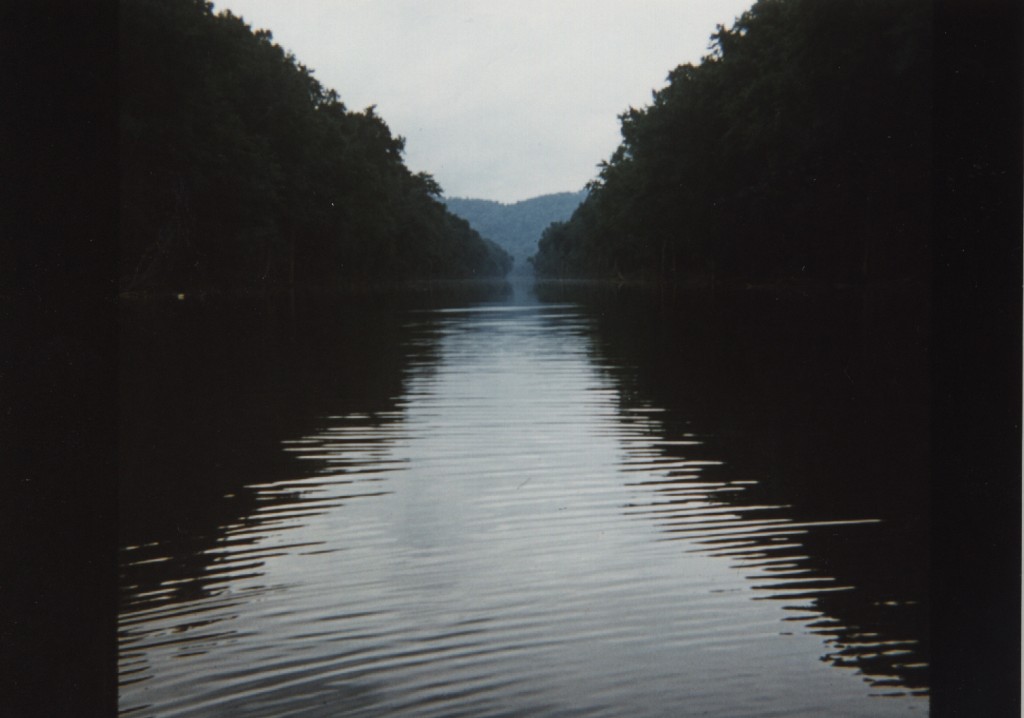
I’ve always been like this. Even as a kid in Kentucky, I could not stand being a lowlander. But it was difficult to find easily accessible lofty locations.  Farmers did not take kindly to kids hopping their fences and ignoring their “keep out” signs.  I’d heard tales of shotguns full of rock salt being discharged at would be hill climbers.  The nearest large tract of “public land” was Fort Knox Military Reservation. In those days, I used to paddle my canoe (illegally) on the Salt River as it wound its way through Fort Knox.  But by afternoon, I grew tired of watching live ammunition fly over my head and explode  in the impact area east of the water. So I’d bring the boat ashore and fight my way through the tangle of wild grapevines and poison ivy to the top of Buzzard’s Roost, 300 feet above the river, and observe the military fireworks from on high.

But I just couldn’t get high enough. I felt absolutely stifled in the closed-in and smothering green forests, not to mention all those “keep out” signs.  Something had to be done. The West changed all that of course.  I discovered millions of acres of nearly empty public land where I could get high to my heart’s content. For the last 20 years, I’ve been seeking out the high spots for no other reason than I just like the view.
None of these ascents was the kind that could make an adrenalin junkie happy. I’ve never much cared for the technical aspects of climbing. All that rope and hardware was just too intimidating. And I’m scared of precipitous heights. How some of my friends can stand on the brink of eternity and stare into the depths without feeling the least bit dizzy is beyond me. I get queazy watching them.
I’ve never even particularly liked walking uphill. As my old friend Joe Stocks once said at a public hearing, “Why would anyone in their right minds enjoy carrying a 50 pound pack on their back and walking all day?” Joe did that in Vietnam and that was all the serious hiking he needed for a lifetime.
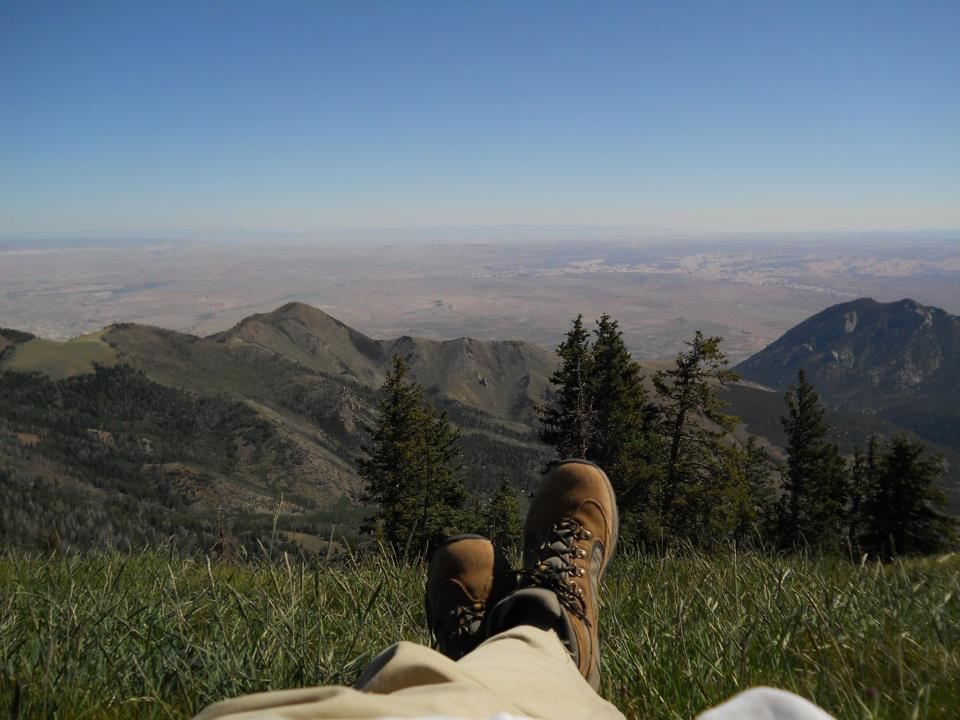
Still, the only way my conscience allows me to get to the top of the hill when there is no road is with my feet. And so I reluctantly use them, sore and blistered as they may become, to get to where I want to go. Once I reach my viewpoint, I am more than content to just sit there along the ridgeline or the top of the mountain or the edge of the canyon and stare blankly at the scene beneath my feet and spit sunflower seeds and sip water for the better part of an afternoon. I’ve frustrated many a fellow hiker who, as part of their aerobics workout insisted that we maintain a high pulse rate for a designated period of time.
I couldn’t be budged. Jog in place, I suggested. Or abandon me, for that matter. Just don’t ask me to move once I’ve settled into my new viewpoint. To find the right spot facing the right direction, where I can reach my pack without disrupting my gaze is all that I ask. At that moment, I am as content as I ever can be.

But what is it about the view?  From that height, the scene is mostly static. Nothing below seems to move. I could just as well look at a photograph or go to the IMAX theater. But I always remember what the poet said:
I have spread my dreams beneath your feet; Tread softly because you tread on my dreams.

From up there, if I squint just right, and the light is just right, and my imagination is willing to play a few tricks, I can see all the country I love, the way I want it to be. Unspoiled. Silent. Even forgotten. Being born 50 years too late doesn’t bother me when I’m up there, because as far as I’m concerned it is 50 years ago.
That felt particularly true to me last week. I was wandering the foothills of a favorite mountain of mine, first in the Scum-mobile on old jeep roads, then on foot, with no particular destination in mind. I still don’t understand why people feel such a great need to know where they’re going, why they insist on being so damn destination-oriented, but that’s an old bellyache of mine and not worth repeating again (for now). But in the process of not knowing where I was going, I stumbled upon the most extraordinary campsite I have ever seen.
On an exposed point of ground, with an unobstructed view, I came upon a cluster of boulders. Granitic boulders as big as a house. They had been sculpted by wind and rain over countless millennia into fantastic shapes, creating alcoves and caves and shelves of every size and form imaginable. On the north side of the big rock, the faded remains of two pictographs, a human figure and a bighorn, still clung tenaciously to the weathered stone. And nearby a cowboy had left an inscription and a date that left more of an impression on me than the ancient rock painting.
It was the date that caught my eye: December 6, 1941. What this cowboy was doing in the high country on that Saturday afternoon is long forgotten by now. But whoever he was and why ever he was there, the date he left behind had more significance than he could have known.
The next day, the Japanese launched a surprise attack on Pearl Harbor and thrust this country into World War II. Everything that has happened to us since then goes back to that morning. It is one of those watershed moments in history where one era closes and another begins. Even here in what was the most isolated section of the United States, the race to build an atomic bomb before Hitler’s scientists could annihilate us, eventually led to the uranium boom, a rush of people to SE Utah, and the construction of thousands of miles of roads and jeep trails. Where would recreationists be today without Tojo, Hitler and J. Robert Oppenheimer?
Whoever the cowboy was that sat in that alcove and scratched his initials in the rock looked out over the same land that I beheld for the first time last week. But to see it and feel it the way he did, I really had to squint.
And where was this penultimate campsite that I even dream about from time to time?
I can’t remember.

Posted in Uncategorized.


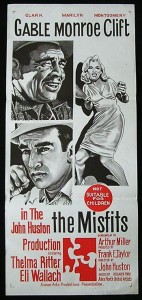
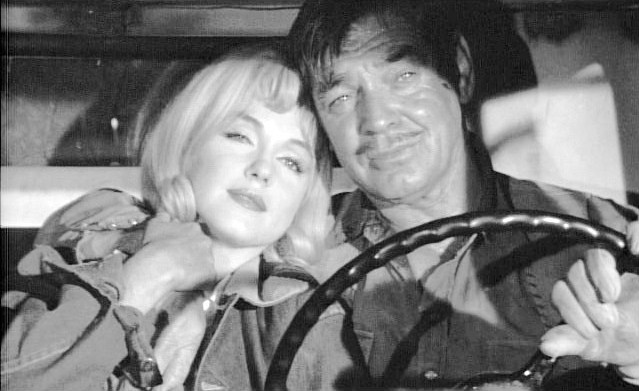
(The Zephyr’s favorite Westerns) This time: “THE MISFITS”

THE MISFITS (1961)

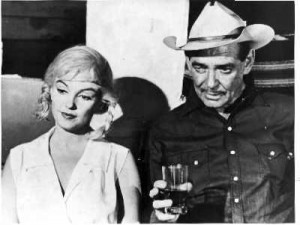
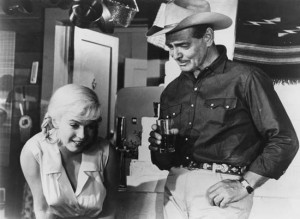
Clark Gable(Gaylord Langlan) Marilyn Monroe (Roslyn Tabor) Montgomery Clift (Pearce Howland ) Thelma Ritter (Isabelle Stears)

Screenplay by Arthur Miller

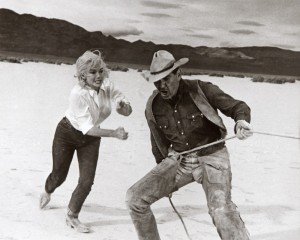
For Gable, Monroe and Clift, this was their last film of note. They would all be dead within three years of the release of “The Misfits.” Montgomery Clift was always a brilliant actor, so there’s no surprise here that his performance is so memorable. But Gable usually played Gable and Marilyn played herself.. When you see these performances, you’ve got to think they both knew this was their last chance to get it right. And they did. The screenplay was by Arthur Miller, one of MM’s ex-husbands. He actually wrote the short story upon which the screenplay was based, in Reno, while waiting for his divorce. That of course is the theme upon which the film is constructed. But for me, it’s the first film that acknowledges how rapidly the West was changing. It had seen a long period of rest, through the first half of the 20th Century. Now all that was changing.

“I can smell a cowboy…I can smell the look in your face. But I love every miserable one of you…’Course you’re all good for nuthin’.

“That may be but it’s better than wages.”

Gay on Educated Women…

“Oh..I like educated women alright. But they’re always tryin’ to figure out what we’re thinkin’….Did you ever get to know a man better by askin’ him questions?”

Roslyn asks Gay…

“What do you do with yourself?

“Just live.”

“How do you just live?”

“Well…you start by goin’ to sleep. You get up when you feel like it. You scratch yourself. You fry yourself some eggs. You see what kind of day it is. You throw stones at a can. You whistle.”

Isabelle tells Rosalyn,

“Cowboys are the last real men left in the world. And they’re about as reliable as jack rabbits.”

“Is anybody any different? Maybe you’re not supposed to believe what people say…Maybe it’s not even fair to them.”


Isabelle on Nevada…

“Welcome to Nevada…the Leave it State…You got money you want to gamble? Leave it here. You got a wife you wanna get rid of? Get rid of her here. Extra atom bombs you don’t need? Blow it up here. Nobody’s going to mind in the slightest. The slogan of Nevada is: Anything goes. But don’t complain if it went.”

“You know, sometimes when a person don’t know what to do, the best thing to do is just stand still.”…..Gay

“Ever hear the story about the city man out in the country? And he sees this feler sitting on his porch and he says, ‘Mister, can you tell me how to get back to town?’ And the feller says, ‘Nope.’ So he says, “Can you tell me how to find the post office?’ And the feller says, ‘Nope.’ ‘Well can you tell me how to find the railroad station?’ And he says, ‘No.’ So the city man says, ‘Boy, you don’t know much do you?’ And the feller says, ‘Nope…but I’m not lost.’”…Gay

Guido to Roslyn on Life…

“Knowin’ things don’t matter much. What you got Roslyn is a lot more important…You care. What happens to anybody happens to you. You’re really hooked in to the whole thing, Roslyn…It’s a gift.”

“People say I’m just nervous.”

“If it weren’t for nervous people in the world, we’d still be eating each other.”

Gay on Mustanging…

“Nothing can live unless something dies. I herd these horses so I can keep myself free. So I’m a free man. That’s why you like me, isn’t it? If it’s bad, then maybe you have to take a little of the bad with the good. Or else you’ll be running for the rest of your life.”

“Don’t want nobody makin’ up my mind for me, that’s all. Damn ‘em all. Changed it. They changed it all around. Smeared it all over with blood. I’m finished with it. It’s like ropin’ a dream now. I jus’ got to find another way to be alive, that’s all…if there is one anymore…”


Here is a link to installment #1:  “THE SHOOTIST” (CLICK THE IMAGES)

AND TO #2: “ONE-EYED JACKS”

Posted in Uncategorized.


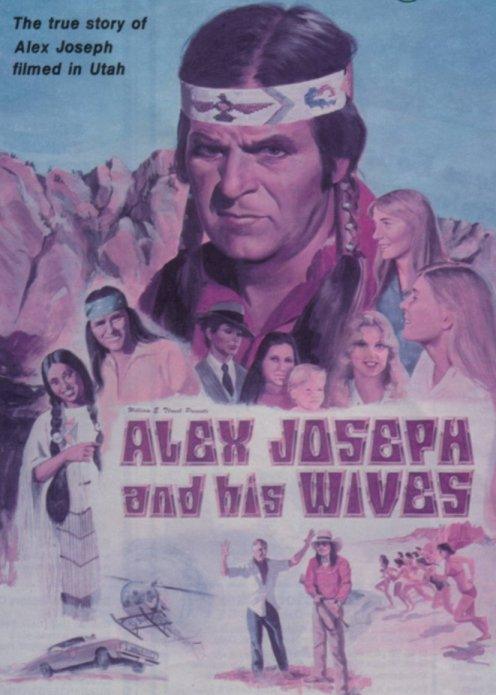
REMEMBERING ALEX JOSEPH & GLEN CANYON CITY —Stiles

Bad Times Coming at Big Water (& Remembering Alex Joseph)

(From the June/July 1999 archives)

For decades, the state of Utah and the federal government have been wrangling over the disposition of state school trust lands. Within each township in Utah are four state sections. Those sections were supposed to generate revenue for the state, but because of the random distribution of those sections they often wound up in the middle of national parks. Utah claimed that the landlocked nature of those state sections limited their ability to be developed and exploited. At one point Utah actually threatened to turn one state section at Arches National Park into an RV campground.

A couple of years ago, Governor Leavitt and Secretary of the Interior Bruce Babbitt worked out a huge land swap. It sounded like a good idea at the time. Recently, however, I read that Utah has acquired an enormous 44,000 acre parcel of land in southern Utah as part of the trade that could forever change this isolated and…colorful corner of the state.

It’s called Big Water and right now it’s not much to look at. A smattering of sunbleached double-wides and rusty butler buildings dot the landscape, along with a generous helping of broken down pickup trucks and washing machines. But if the Utah School and Institutional Trust Lands Administration has its way, life is going to change dramatically. The state agency wants to develop the land for its tourist and retirement community potential—Sun City Utah-style—and projects that in the decades ahead, “tens of thousands” of people will build homes there. Sitting on the edge of Escalante/Grand Staircase National Monument and just a stone’s throw from Lake Powell, it is bound to attract vast numbers of would-be buyers and land speculators.

No one will feel the change more than the current residents of this marginal little town. Until now, Big Water’s greatest claim to fame was its outspoken and flamboyant polygamist leader, Alex Joseph. Until his death last year, Alex and his twenty-odd wives (the number fluctuated over the years) have lived out there on the edge of forever for decades.

Twenty years ago, they called the town Glen Canyon City and Alex and his women ran the Red Desert Cafe. I was wandering that summer, trying to find a place to throw down some roots and for a while I almost wound up in Kanab. I’d heard about Alex and the rumor that he had the prettiest wives in southern Utah, so on my way to Kanab, I stopped at the Cafe for breakfast one morning.

The rumors were all true. One of his wives was a doctor, another was a lawyer…they were all beautiful. Then Alex came in. He had a beer gut and stringy black hair pulled back in a ponytail and he needed a shave and I thought: What does this guy have that I don’t have?

But he had something because the Joseph women seemed to almost swoon when they saw Alex. “You’d just have to get to know him like we do, to understand,” one of the women explained. Then she blushed and said, “Well maybe not like we know him.”

I chatted with Alex and his sidekick for a few minutes. His buddy was the spitting image of Wild Bill Hickock, from the handlebar mustache to the fringed deerskin coat. Then I said my goodbyes to the wives and left for Kanab. A couple weeks later I found myself applying for a job as a teacher’s assistant at the Kane County High School. I had an interview with the principal and the superintendent of schools and I had even shaved off my beard for the occasion. Despite my squeaky clean look, I sensed hostility. They asked me if I knew anyone in Kanab.

“Well…not here in Kanab,” I explained, “But I do know Alex Joseph.”

I don’t what I was thinking about. Maybe I had a death wish. Maybe I’d already sub-consciously determined that Kanab was not the place for me.

“Alex Jo–,” the principal caught himself. He stared at me for a moment, then he leaned back and smiled. “Old Alex…he’s getting noisy again out there at Glen City. Lavar, when was the last time we had a little…chat with Alex?” He winked and grinned at me.

“Been a couple o’ years I’d say, Bob. Are you thinkin’ it’s time to pay the Josephs another visit?”

“I think that’s just what we need to do,” said Bob.

The conversation between them continued for a few minutes and they almost forgot I was there. Finally, I was offered a part-time job. Eight hours a week at minimum wage. I shaved off my beard for this? I thought. I declined their kind offer and left immediately for Moab. On the drive back, I stopped again at the Red Desert Cafe, this time to warn the Josephs of the veiled threats. One of the wives ran and found Alex and a moment later I was telling my “Bob and Lavar” story to Alex and Wild Bill.

Alex rolled his eyes and chuckled. “If those fellers come snooping around here, I don’t reckon they’ll be a problem.” He pulled back his jacket and revealed what looked to be a Colt .45 stuffed in his belt. Wild Bill opened both sides his fringe coat and said, “That goes double for me.”

I left town and never saw Alex again.

Alex Joseph is gone now and I doubt if Big Water will ever see his likes again. It’s too bad because characters like Alex are what have always made the West a special (if not very weird) place. Big Water’s future will turn on big money not tall tales. And what about the men and women who were truly “larger than life?”

No room. No room for characters in the New West.

BONUS YOUTUBE VIDEO:

http://www.youtube.com/watch?v=dcWWcbmWJCg&list=FLvaUWGCUhNweiGt7dMRdu2A&index=1&feature=plpp_video

The Feb/Mar Zephyr (click the cover)

Posted in Uncategorized.


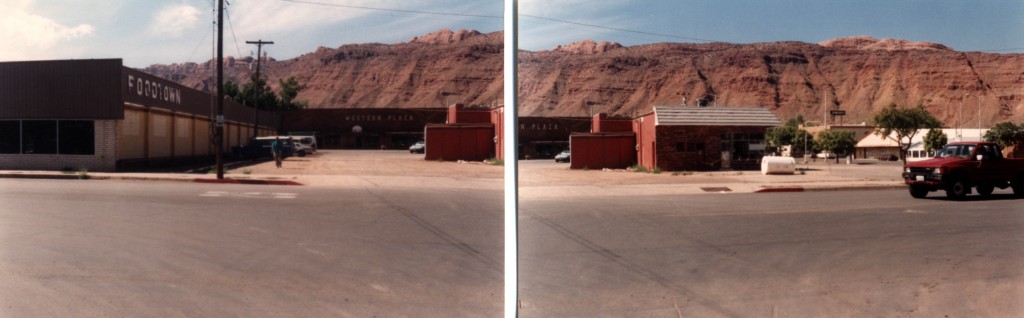
Moab Flashbacks #16: Before the MIC & McStiff’s…Center & Main Sts, 1988

The old FOODTOWN grocery store had gone out of business but the building still stood when this photo was taken in 1988. Leo Burr’s gas station occupied the space now filled by the Moab Visitor Center and the Western Plaza had not become McStiff’s Plaza for a few more years…

click the image to enlarge

Posted in Uncategorized.