The Dec/Jan issue is ONLINE here:

The Canyon Country Zephyr Blog
The Dec/Jan issue is ONLINE here:
Posted in Uncategorized.
rev="post-2189" No comments
– January 12, 2012
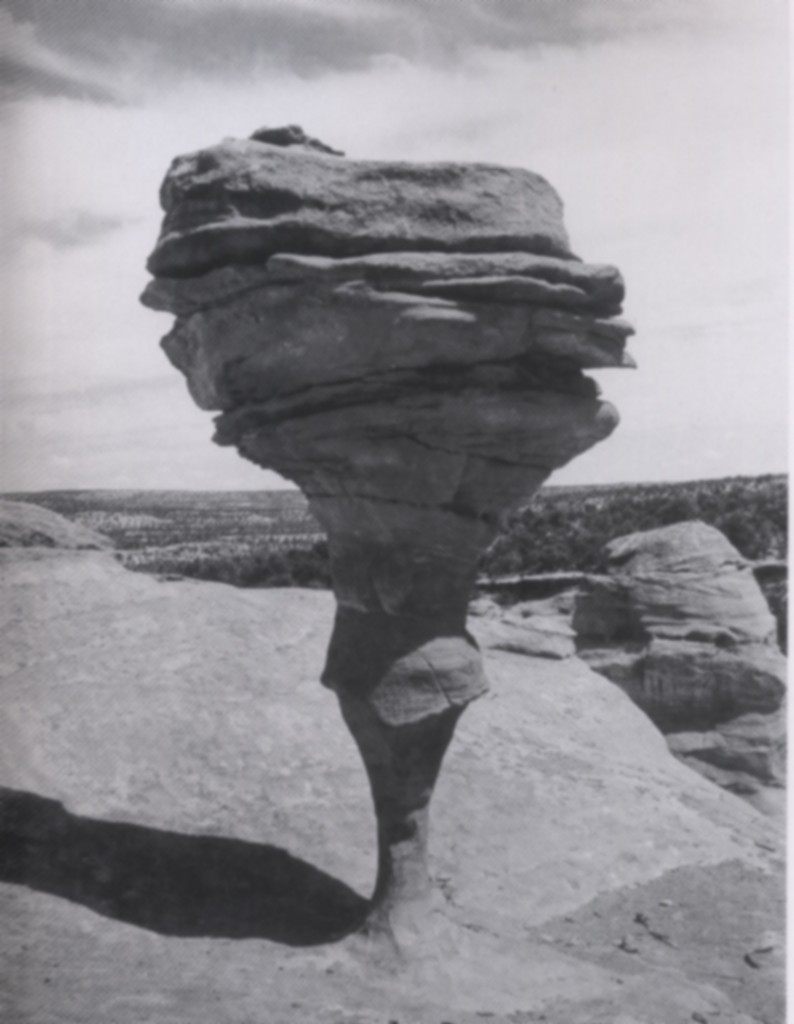
In 1940, Utah: A Guide to the State, was published by the Writers’ Program of the Works Projects Administration. The book was a fascinating and comprehensive look at the Beehive State, and from the perspective of 50 years later, an historical document. Among the thousands of descriptions of cities and towns, parks and forests, historical and geographical oddities comes this observation:
“At 17 miles, a posted trail leads 100 yards to the GOBLET OF VENUS, a piece of freak weather tooling in vermillion sandstone. This goblet bowl, six or seven feet in diameter and weighing about five tons, is delicately balanced atop a symmetrical stem six feet long and not much thicker than a man’s leg.”
Not long after I arrived in this country, I saw a picture of the Goblet of Venus, and immediately wanted to find it. I took the photograph to a friend of mine at Natural Bridges NM, with hopes of getting directions. The information I received was not what I wanted to hear.
It seems I was about 25 years too late. In the early 50s, a group of kids from Blanding drove out to this precariously perched treasure, and with a length of heavy chain, tore the goblet from its fragile pedestal. What took Nature thousands of years to sculpt, required five minutes to destroy.
But recently, while studying the old photograph, it occurred to me that the fallen goblet was still out there somewhere. It took the better part of an afternoon, using my old WPA book, the photograph, and some luck, to finally locate what remains of the Goblet of Venus. The old trail to it has long ago vanished, the pile of rubble is slowly being dissolved into sand and blown away with the wind.
I opened my pack, pulled out a glass goblet of my own, and drank a toast to the Goblet of Venus…Gone, but not forgotten.
Jim Stiles. 1996
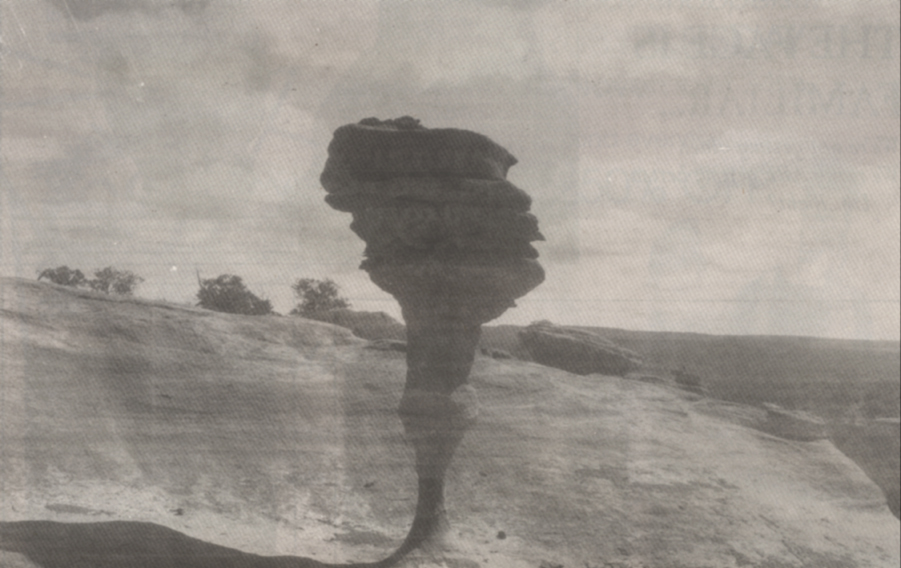
In the 1930s…
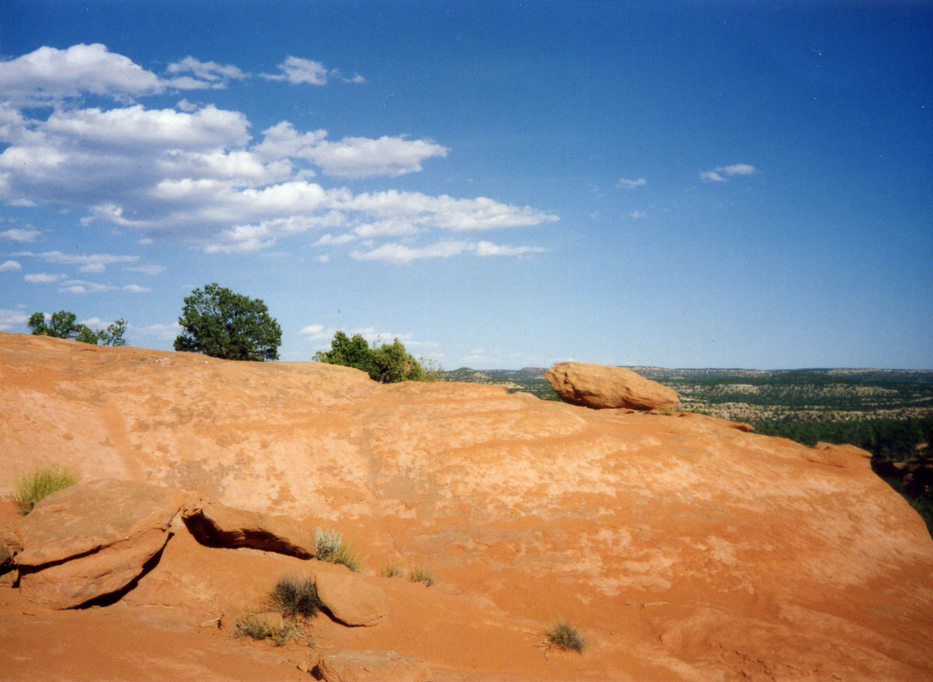
Fifty years later...
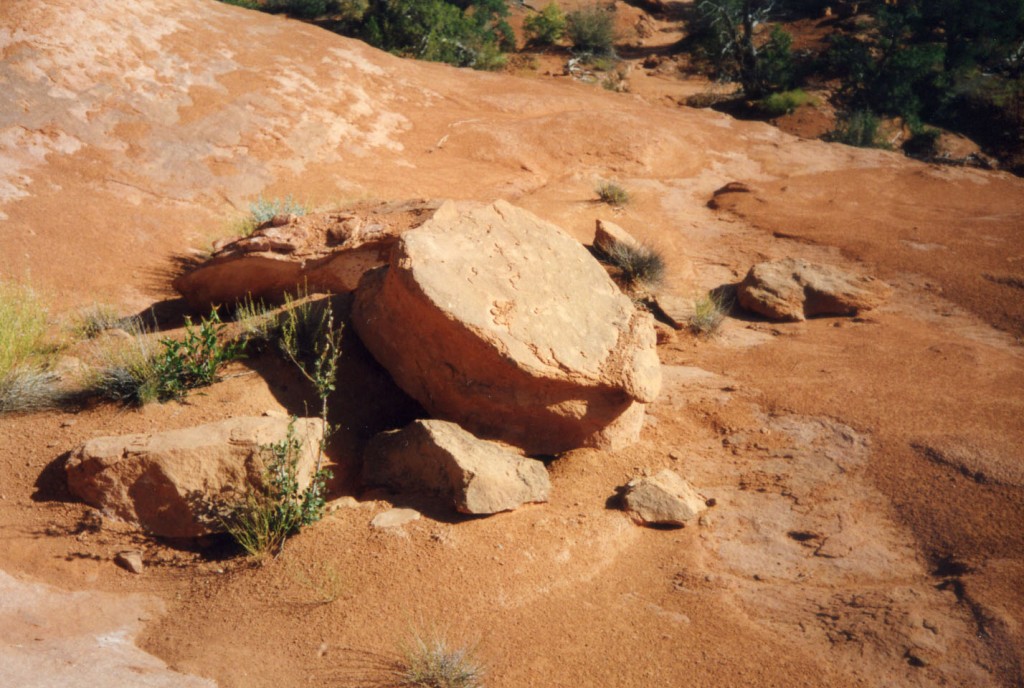
The Remains…
To peruse all of our ZBlog posts, click “The Zephyr” at the top of this page.
To read the Apr/May issue, click the cover below:
Posted in Uncategorized.
rev="post-3916" 235 comments
– January 7, 2012
From our archives: July 2009
For the Homeless in Moab, and those trying to find solutions for the homeless, consider this idea…
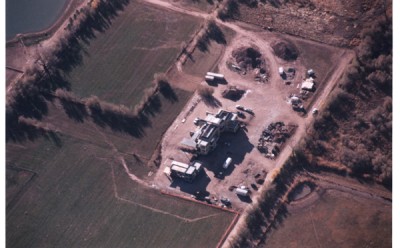
McBonderman House
There was a time, in the very recent past, when Moab, Utah welcomed and easily accommodated a diverse population. Its citizens represented the entire spectrum of American Life. The wealthy had their bigger homes, the vast middle class
lived more modestly, but the lower income working class Moabites could find affordable housing as well. Whether to buy or rent, it was an easy task to make Moab home.
It’s what’s called a “community.”
Of course, to many, all that is gone. A greed-driven economy that extends far beyond the city limits created a new Moab, while its weak, impotent politicians, and a mostly listless apathetic public practically slept through the transformation. Now, barring a long-term collapse of the world economy that drives prices back down (What was Cactus Ed’s mantra? “Our only hope is catastrophe!”), the way Moab is now is the way it is likely to stay.
Except more so.
But when it come to “affordable housing,” perhaps the solution is right under your noses. What is affordable housing after all? A roof over your head. A kitchen to open a can of beans. A bathroom with a toilet that flushes (if you want REAL luxury). What more do you need? For the people who only ask for these simple necessities, perhaps a new Moab resident can offer some aid and comfort.
 David Bonderman! Step forward and lend a hand,
Mr. Bonderman, is “a prominent venture capitalist and major financier for the Southern Utah Wilderness Alliance.” He invests all over the world. He owns power plants in Texas and goes after the coal in Malaysia. He owns an airline in the United Kingdom that claims “Climate Change is Bullshit.” He is also Moab’s wealthiest part-time resident and the owner of Moab’s biggest home. At about 15,000 square feet (not counting out buildings), calling his new digs a “McMansion” doesn’t do it justice. It’s about the size of an airport terminal in a medium sized city.
And it’s a fair bet that Mr. Bonderman will spend very little of his time there. Some close to the billionaire have indicated he has yet to spend a single night at his Moab Palace. Fortune magazine noted a few years back that he spends most of his waking life in his Gulfstream jet, racing around the globe, from deal to deal. And then he also has that mansion in Aspen…
So…why waste all that space?
A lot of Moabites in need of affordable housing could be accommodated at Bonderman’s palace. He’s not there…what the hell does Dave care? I’m sure he has some caretakers in residence who can keep an eye on the place and make sure everyone is picking up after themselves.
This could be the classiest flop house of all time.
And all that land that surrounds his castle? Let’s open that up to the public too. Mr. Bonderman can parcel out all that fertile bottomland to anyone in Moab who wants to grow a garden but hasn’t the space to do it. Bonderman could be known as the man who saw suffering and tried to stop it. Who reached out to the poor and the needy. The man who did the right thing.
The Grand Canyon Trust has already called him “one of the great conservationists in America today.” Now he has the chance to be one of America’s great humanitarians as well.
McBonderman House.. The Bonderman People’s Farm…it’s an idea whose time has come.
—Stiles
Read The Dec/Jan Zephyr online:

Posted in Uncategorized.
rev="post-2076" No comments
– January 6, 2012
This is the first installment in an open ended series—“Poking Through the Ruins…The Way it Was.” It’s intended to be a collection of images, essays, sound and video clips, historical documents, interviews and whatever else strikes our interest, and yours.
We welcome your comments and observations…JS
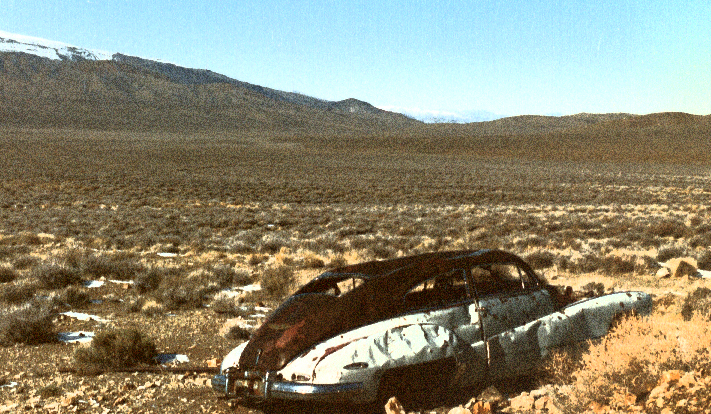 Death Valley, 1979.
Check out the current Zephyr online:

Posted in Uncategorized.
rev="post-2048" No comments
– January 5, 2012
Feds propose allowing wind farm developer to kill golden eagles

“The federal government is proposing to grant a first-of-its-kind permit that would allow the developer of a central Oregon wind-power project to legally kill golden eagles, a regulatory move being closely watched by conservationists.
“The Interior Department’s Fish and Wildlife Service on Tuesday released a draft environmental assessment that would allow West Butte Wind Power LLC to kill as many as three protected golden eagles over five years if the company fulfills its conservation commitments.”
Read the current issue of The Zephyr:

Posted in Uncategorized.
rev="post-2038" No comments
– January 4, 2012
Click the link below to read the entire story in The Atlantic:
WHY DO LIBERALS KEEP SANITIZING OBAMA?

An excerpt from The Atlantic:
“Telling the story of Obama’s first term without including any of it is a shocking failure of liberalism. It’s akin to conservatism’s unforgivable myopia and apologia during the Bush Administration. Are liberals really more discontented with Obama’s failure to reverse the Bush tax cuts than the citizen death warrants he is signing? Is his ham-handed handling of the debt-ceiling really more worthy of mention than the illegal war he waged? Is his willingness to sign deficit reduction that cuts entitlement spending more objectionable than the fact that he outsourced drone strikes to a CIA that often didn’t even know the names of the people it was killing?
“These are the priorities of a perverted liberalism.
“Chait’s essay suggests an ideological movement that finds the ACLU and Center for Constitutional Rights indispensable, but only when a Republican is in the White House. One that objects to radically expanded executive power, except when the president seems progressive.
“I want to be reassured that liberalism is better than that.”
Conor Friedersdorf – Conor Friedersdorf is a staff writer at The Atlantic, where he focuses on politics and national affairs. He lives in Venice, California, and is the founding editor of The Best of Journalism, a newsletter devoted to exceptional nonfiction.
Posted in Uncategorized.
rev="post-1989" No comments
– January 4, 2012
From The Zephyr Archives/ June 1994
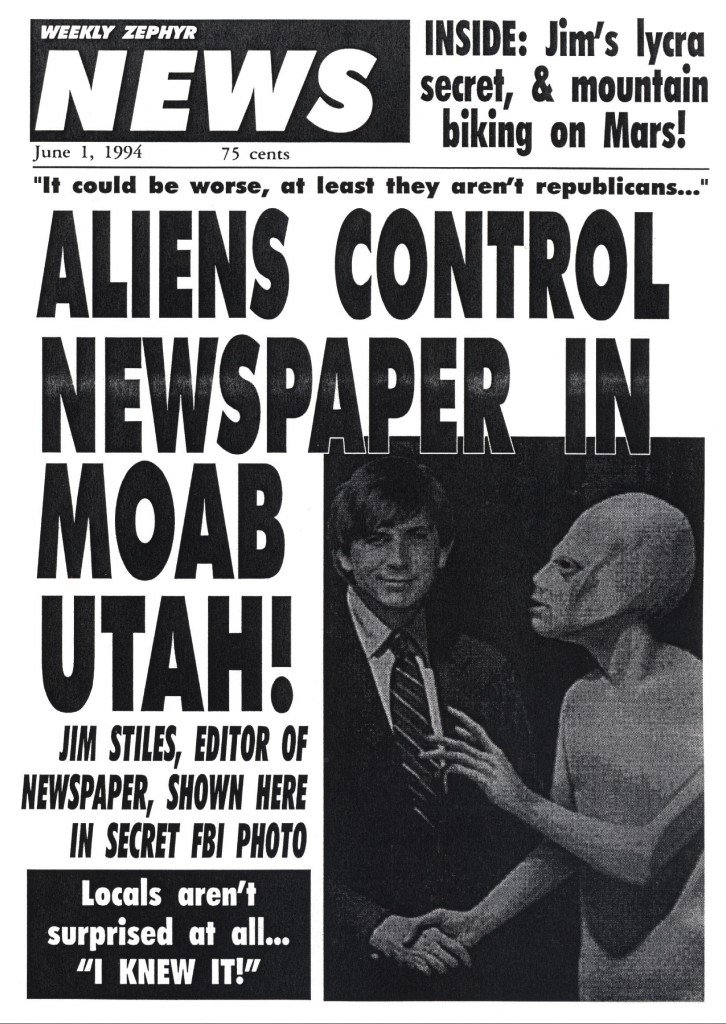
Check out the rest of our blog and the current Zephyr:
http://www.canyoncountryzephyr.com
Posted in Uncategorized.
rev="post-1927" No comments
– January 1, 2012
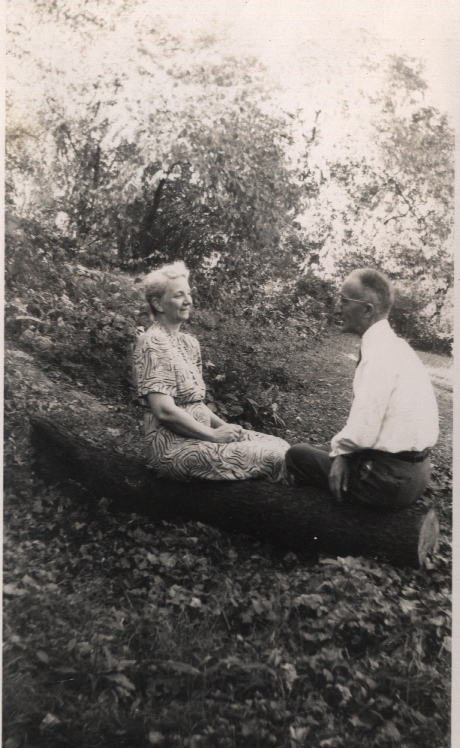
This time of year, I always think of my grandparents. They died many years ago; in fact, more time has passed since their passing than the years I was able to spend with them. Yet, there is scarcely a day that passes that I do not think of Grandpa and Grandma. My grandfather was born in Concordia, Kansas in 1882, the oldest of six children and, as a boy, once saw Wyatt Earp; yet he lived to see men walk on the moon. He used to tell me he’d lived the best part of America and I think he was probably right.
Frank Montfort was not a great success; at least in the way most of us measure it these days. He never made a lot of money and he never acquired any fame. In fact, he struggled to make a living throughout much of the Depression and at one point, very briefly, when he’d hit rock bottom, could only find comfort in a bottle of whiskey. But he overcame all that, driven by his own pride and his love for his family.
My grandparents stay close to my heart after all these years. They were fair-minded without being judgmental, honest without being opinionated…and their love was unconditional. As a teenager I was in and out of trouble from time to time, but my grandparents’ support never wavered. My grandpa would smile and put his arm on my shoulder and say, “Jim, I don’t always understand you, but I love you and I’m behind you 100%.” It’s amazing how much those few words can mean.
Recently, on a trip home, I found some journals that my grandfather had kept for almost 20 years, buried in the bottom of his cedar chest. We had not known they existed. The family read his entries cover to cover, and what struck us all was the absence, in all those years, of any unkind sentiment toward anyone–not even my crazy Aunt Elizabeth with the blue hair. He was incapable of it.
At Christmas I remember this story about my grandparents and my mother during a particularly rough winter more than 70 years ago. Most of what follows is true…
My mother was only five years old in the cold and bitter winter of 1932. It was bitter for more reasons than the freezing temperatures and early snowfalls that fell upon the Ohio River Valley. For twenty-five million Americans, one-third of the work force. There were no jobs and no prospect for work. Families that just a few years earlier had been a part of the nation’s safe and secure middle class, now found themselves homeless and hungry. My mother’s father, my grandfather, was one of the unemployed.
A few weeks earlier, Franklin Roosevelt had been elected President and he had promised a New Deal for Americans. In a few weeks he would tell his fellow citizens that “the only thing they had to fear was Fear itself.” For now, however, there was the basic fear of hunger and cold and hopelessness.
Sue (my mother’s name) often overheard the grim conversations between her parents and it scared her. How was he going to keep food on the table, my grandfather would ask my grandmother, and she would softly reassure him, “You’ll find a way, Frank.” Sue asked her father why they were poor; he smiled wanly and tried to explain, “It’s the Depression,” he said. “Everybody’s poor.”
That helped a little. At least her family wasn’t alone. But the Depression? It was hard to explain to a five year old.
As the month of December and the Christmas season approached, Frank and Susan and Sue Montfort could be thankful that they still had their home, that they’d canned many vegetables from their summer garden for the winter, and that they were all healthy. But job prospects were grim and the family’s savings were almost depleted. While window shopping on Fourth Street, Sue had eyed a red checkered dress at Stewart’s Dry Goods. But her mother dampened her hopes—Santa was having a bad year too, she explained. There may not be many presents under the tree. My grandfather feared there might not even be a tree. Or a turkey. Nothing. It was that tight.
One afternoon, Frank decided to take a walk. Somehow he felt better when he was moving, for when he sat, he thought. He thought about his family’s dilemma and his inability to change it. So, wrapped in a worn wool overcoat, he shoved his hands deep in the coat’s pockets and moved briskly up Birchwood to Frankfort Ave.
Frankfort Avenue was the commercial center of the Crescent Hills section of Louisville. Its sidewalks were lined with small shops and markets, although many of them were closed and boarded up. As he watched the lined and worried faces of the people he passed, my grandfather stifled the urge to sink into self-pity. He knew he had no right to feel victimized for he was surrounded by other victims. He was not alone.
For that reason, Frank almost felt guilty when he was suddenly confronted with a stroke of remarkable good luck. He had just passed beneath the marquee of the old Crescent Theatre when a man appeared behind the ticket window of the box office. The man was holding a small cardboard sign. In crude handwritten letters it said: HELP WANTED.
For a long moment my grandfather could scarcely believe his eyes or good fortune before he ran inside. In a few minutes, Frank Montfort was the new ticket collector at the Crescent Theatre. He glanced through the ticket window and saw a dozen faces fall as the manager removed the “help wanted” sign. He knew that a matter of seconds could have changed everything, and he could have been on the outside looking in. But he wisely decided not to flog himself too severely for his good fortune. After all, he’d been recently plagued by nothing but bad news—he could go home today with a smile on his face.
In reality, Frank was happier than he had a right to be. The job was nothing permanent; he was hired only for a week to help out during the Christmas rush. And the job paid twenty dollars. Twenty bucks. But that amount of cash could go a long way in 1932. He could get a turkey and all the side-dishes that go with it to make a proper Christmas dinner. He could afford a tree, and maybe if he was very careful, still have enough money left over to get that red checkered dress.
My grandfather brought the news home to his wife and daughter, and the next day he started work at the theatre. Collecting tickets at a movie matinee did not exactly challenge Frank’s intellect, but it never even occurred to him to complain. He was grateful just to be there and the days passed quickly. On the morning of Christmas Eve, the manager called him into the office, and handed him a crisp $20 bill. Whether the theatre would need additional help after Christmas depended on the crowds the manager explained, and he added—stay in touch. My grandfather nodded, shook the man’s hand, and put the bill in his coat pocket.
There was an extra bounce in his step as Frank walked briskly down Frankfort Ave. His sister Louise and her husband Ham planned to stop by the house later. Ham and Louise had a car, and with their help, Frank and Susan hoped to find a turkey, a tree and that special Christmas dress for Sue.
As he prepared to cross the street to Birchwood Avenue, Frank passed a man standing alone by a lamppost. His face was dirty and unshaven, his clothes were in tatters. His hands were wrapped in rags. Clutched in his fingers was a pint of Kentucky bourbon, a cheap brand, and as my grandfather walked in front of him, the man tried to hide the bottle. My grandfather looked away; Frank knew that had the breaks gone differently, the man could just as easily have been himself. Again.
Mother and daughter were waiting when Frank appeared around the corner. He was almost running when he hit the front steps. Susan lifted the hat from his head and brushed off the snow that was just beginning to fall. Frank smiled and reached into his coat pocket…
“I’d better turn this over to you before ….”
He stopped short. The broad smile vanished. He reached deeper into his pocket but the bill was not there.
“Check your other pocket,” my grandmother suggested, and he did. But he knew where he’d placed the $20 bill. He went back to the pocket and probed every inch of it. And he felt along the seam where the threads had worn out and separated and created a ragged hole just large enough for a piece of paper money to silently slip through and fall to the ground.
“It’s gone,” my grandfather said. “It’s gone.” His lips formed the words again, but he made no sound. He sank down in the couch and buried his face in his hands. For a moment, no one said anything. No one moved. But my grandmother, an eternal optimist, broke the silence.
“Maybe you can find it,” she said. “Maybe it’s still lying on the sidewalk.”
Frank looked scornfully at his wife and shook his head. She had to be kidding, he thought. That money probably never had a chance to reach the sidewalk before someone else grabbed it. Not in these times. But Susan insisted that he at least try, and for lack of a better idea, Frank agreed.
My grandfather scoured the sidewalk and gutter as he dashed up Birchwood. He walked in a sort of crouch, his eyes glued to the ground, and he must have looked very strange to the pedestrians he passed. When he reached Frankfort Avenue, he knew it was hopeless. Before, the sidewalks were relatively empty, but here the foot traffic was heavy. There were people everywhere. But for form’s sake, if nothing else, he continued onward toward the theatre.
He moved slowly along the sidewalk’s edge, hoping the bill had fallen over the curb where it might not be noticed. He was still in that crouch staring intently at the concrete, when a voice spoke to him from over his shoulder. Frank spun around.
“Lookin’ for something?”
It was the man with the cheap bourbon…..
He was still leaning against the lamp post. My grandfather shifted his weight uneasily and tried to explain, but he was embarrassed and disheartened and tired and he could not speak.
“Forget it,” said the man with the bottle. He took a swig, winced and wiped his mouth with his sleeve.
“Anyway,” he went on, “I figured you’d be back.”
He lifted one worn out leather shoe with a flapping sole from the sidewalk. There was something beneath it.
“Merry Christmas,” said the man.
It was the twenty-dollar bill.
Darkness had chased away the last light of day, my grandmother peered through the frosted windowpanes into the blackness, but it was her daughter who first saw the two figures, dimly lit by the streetlights, trudging through the snow and slush. Out of the silence of a snowfall, came the sounds. It was the sound of two grown men singing Jingle Bells, at the very top of their lungs.
On Christmas Day, the Montforts had a guest for dinner.
—Jim Stiles
—
www.canyoncountryzephyr.com
Posted in Uncategorized.
rev="post-1815" No comments
– December 25, 2011
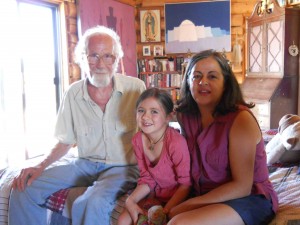
Anorther photo of John, Isabel & Noelle at their magnificent desert hideaway
Posted in Uncategorized.
rev="post-1740" No comments
– August 19, 2011
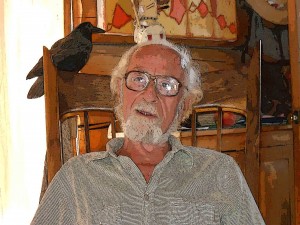
John Depuy at home in the middle of nowhere with his raven
Tonya and I visited John and Isabel Depuy last week at their remote desert home in New Mexico. We’re happy to report that the Depuys and their beautiful daughter Noelle are doing well, despite the persistent heat, drought and nearby wildfires. Everyone is ready for summer to end.
Look for a full accounting of our afternoon with John and Isabel and hopefully a peak at some of their new art. If you are interested in purchasing a painting, their email address is: ravensmount@yahoo.com
JS
Posted in Uncategorized.
rev="post-1722" No comments
– August 17, 2011