HOW CHRISTIANITY ‘WON THE WEST’ & DESTROYED A CULTURE (from the 2006 Zephyr archives)
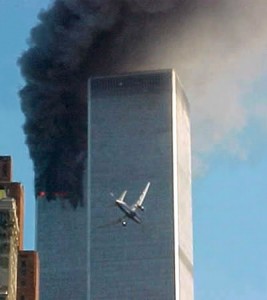
When the world watched in collective horror on September 11, 2001, as jet liners piloted by Islamic terrorists slammed into the World Trade Center towers in New York City, viewers could scarcely comprehend the human disaster unfolding ‘live’ before them. In the days and weeks after the towers collapsed, and the Pentagon fires were extinguished, and the wreckage of Flight 93 in Pennsylvania was removed, after the sheer enormity of the attacks was absorbed by unwilling minds and the numbers of dead, more than 3000, were confirmed, the shock and grief of that day gave way to an angry national mood that demanded quick and total revenge and retribution.
Calls for retaliation came sooner for some than others. During the first days, most of the news coverage dealt with the disaster itself and the stunning loss of life. When Mayor Giulliani told reporters that the death toll “would be more than any of us can bear,” he was not yet prepared to re-focus his attention on the attackers—his heart and his tears remained with his city and with the victims.
But elsewhere, retaliation was already on the minds of many. FOX News was the first of the networks to suggest, as early as 2 pm on 9/11, possible enemy targets and urged swift and brutal attacks on those responsible. That evening, President Bush warned other nations that a full military response was imminent and that nations harboring terrorists would be just as much at risk as the terrorists themselves. And rightly so.
The United States had an absolute right to protect itself from further assaults and when it launched retaliatory strikes against the Taliban in Afghanistan, two months after 9/11, the world community stood behind it.
But it is undeniable that many Americans view the conflict between Islamic extremists and the United States as something much broader than a War on Terror. They see it just as fervently and narrowly as their enemies—it is a war between the Christian and Islamic worlds, with both sides longing for another “crusade” and a definitive outcome.
In fact, both sides in this struggle have far more in common than either would admit. We Americans tend to view the world in very stark black & white terms and in fact we know little of other world cultures. There is an assumption by most Americans that goes far beyond arrogance, that interprets anti-American sentiment to be pure jealousy, plain and simple—that we simply have more than anyone else and the less blessed members of the world community resent our affluence. It never occurs to us that other countries and other cultures might prefer to choose a different lifestyle.
But Americans, a self-proclaimed Christian Nation, have been making that assumption for centuries now, and few of us are willing to admit it. The record is there, for all of us to examine, but rarely do we take the time, or have the incentive, and when we do, what we find is too disturbing to repeat.
In the early years of the 21st Century we condemn the violent and extreme practices of Islamic warriors, but our long history in America shows that Christians have been just as brutal. Just as cruel. And just as blind to the core principles of our faith…
 We gave them forest-clad mountains and valleys full of game, and in return what did they give our warriors and women? Rum and trinkets. And a grave.
—Tecumseh
In 1845, fewer than 20,000 white Americans lived west of the Mississippi River. The vast wilderness that stretched from the Great Plains to the Pacific Coast was home to a million Native Americans and a hundred tribes. By mid-Century whites had already driven the original occupants of eastern tribes from their ancestral homes. Now many Indians hoped that they might be left alone to live their lives as they chose to, “for as long as the grass grew and the rivers ran.”
But as white Americans expanded west, conflict was inevitable. Two incredibly different cultures would soon compete for the same space. Charlotte Black Elk, a Lakota Sioux writer and historian, observes the clash most clearly. “With Judaeo-Christian people, you have an origin legend that says, ‘Adam and Even were banished to Earth and Earth is an enemy,’ and you have Native American people who say, ‘The Earth is my mother and we all have to live together as a family.’ Those are very opposing viewpoints, from one that says ‘this is my mother’ to ‘this is a place of banishment, and you don’t really have to care for it because you’re going back to Paradise after you finish your banishment.’”
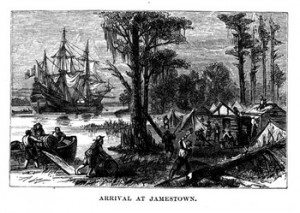
When the first settlers to North America landed at Jamestown, Virginia in 1607, more than 10 million Indians occupied the North American continent. In the next three centuries, the Native American population would be decimated by their white conquerors. Famine, disease and war would reduce their original numbers by 90%.
The most shameful episode in American history began almost as soon as the Jamestown colony stepped from the boat. Within years, Indians were stripped of their property and regarded as sub-human by most of the Christian colonizers. When the Cherokee Nation represented itself before the United States Supreme Court, in defense of its land and its right to live side-by-side with whites, and when the Court ruled in favor of the Cherokee, the President of the United States, Andrew Jackson, defied the court order and shipped thousands of Native Americans west to “Indian Territory.”
Jackson wrote, “These tribes cannot exist, surrounded by our settlements and in continual contact with our citizens. 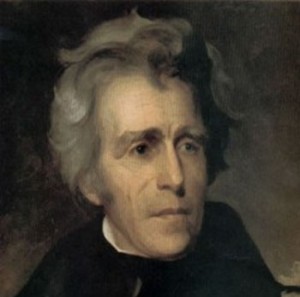 They have neither the intelligence, the industry, the moral habits, nor the desire of improvement. They must necessarily yield to the force of circumstance and before long, disappear.”
More than half of the exiles died on the bitter journey. It is still called “The Trail of Tears.”
Still, the western United States was so vast and so unlimited, that conflict over that space seemed like a distant problem, for another time. When Lewis & Clark reported to President Jefferson on their voyage of discovery to the Pacific, he could barely comprehend the vastness of continent that sprawled to the west.. He concluded, based on their report, that it would take 1000 years to settle the continent from Atlantic to Pacific.
Except for Lewis & Clark, and the trappers, little was known of the Great Plains and the land beyond it. Cartographers called that land “the Great American Desert,” convinced of its lack of value and therefore certain that Native Americans would never be asked to give it up. All that would change in the coming decade of the 1850s.
Soon there will come from the rising sun a man different from any you have ever seen. They will bring a book that will teach you everything. Then the world will fall to pieces.
—Native American Prophesy
Sometimes the flow of events, unconnected by time and space, can conspire to change history. In the late 1840s, America and the world was transformed in such a way. Travel from the east to the Pacific was almost an impossible task, and only the most rugged attempted it. But in 1846, an American explorer named John C. Fremont published a book, one of America’s first travel guides, in fact, that offered tantalizing information about a route west, through South Pass in Wyoming. South Pass allowed travelers to bypass the nearly insurmountable Rocky Mountains; news of this revelation spread like a prairie fire.
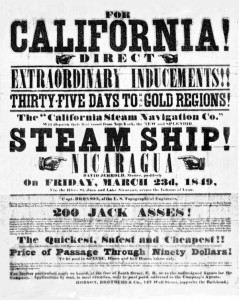 Two years later, when gold was found at Sutter’s Mill in California, and news of it reached the east, the reaction was unprecedented. Tens of thousands of white Americans left their homes and families, in search of quick riches in California. Thousands more, encouraged by Fremont’s maps, went west as well, hoping for land and a fresh start. None of them gave more than a passing thought to the Native Americans who had occupied these lands for thousands of years. If anything, the Indians were nothing but an obstacle to be overcome. As historian Robert Utley observed, “They considered it their destiny to overspread the continent and make it blossom, as commanded by the scriptures, and I don’t think ‘right’ ever played any part in the decision to move west. It was a natural and inevitable thing in the minds of westering Americans. Morality lay in making the wilderness bloom. ‘Right’ was conquering the continent.”
What was about to be lost by the Native American tribes of the Great Plains was, as historian Stephen Ambrose described, “a freedom the likes of which the world has never known.” The horse, first brought to North America by the Spaniards and later abandoned by them, changed the lives of the Plains Indians. They were able to hunt the buffalo with unprecedented efficiency, so that the basic needs of the people were always met. The Plains tribes moved with the seasons and at will. The horse and Indian formed a partnership that would go unchallenged for little more than a century.
Ten years after gold was discovered, more than half a million white Americans had moved to California. San Francisco grew from less than 500 to 20,000 in a year. Thousands more swarmed into the “Great American Desert,” stunned at the extraordinary fertility of the soil. News of more gold strikes in Colorado created more human stampedes from the east. Tensions between Plains tribes and the whites increased dramatically. As early as 1851, the U.S. government attempted to resolve the problem by encouraging Indians to move onto reservations, but their efforts were strongly resisted by most Native Americans. Why would they trade rich hunting grounds for barren tracts of worthless land?
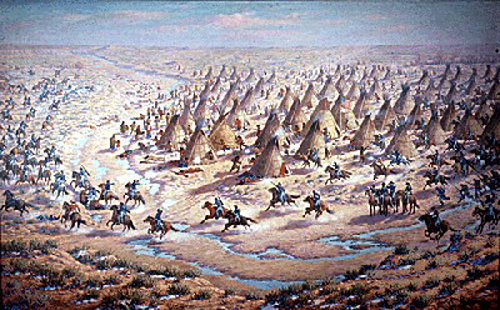
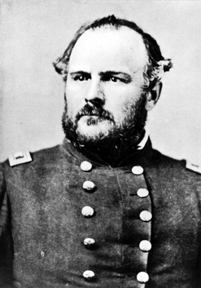 In Colorado, the government pushed for war. When Cheyennes refused to move onto just such a place, Governor John Evans ordered the Colorado militia, led by a former Methodist preacher named John Chivington, to burn villages and kill Cheyennes until resistance to the reservation collapsed, or they’d all been killed. But Evans’ plan began to fall apart when Black Kettle, the leader of the tribe, rode to Denver himself and asked for peace, the last thing Evans had wanted. He ordered Black Kettle and his people to a place called Sand Creek, 75 miles southeast of Denver and told them to wait.
On the cold morning of November 29, 1964, Chivington and his militia of 700 men surrounded the camp at Sand Creek. Black Kettle had hoisted the Stars and Stripes and a white flag of peace as signs of good faith, but Chivington ordered his men to attack. A junior officer protested, arguing that Black Kettle’s people had done nothing to provoke the attack. Chivington replied, “I have come to kill Indians and believe it is right and honorable to use any means under God’s heaven to kill Indians.”
As the soldiers swarmed over the camp, Black Kettle could not believe what was happening and did not think they would harm his people. The soldiers killed women and children and the elderly. Some of the soldiers refused to fight. Captain Silas Souleigh said, “It looked too hard for me to see little children on their knees, begging for their lives and having their brains beaten out like dogs.” Most of the dead were mutilated. “I heard of numerous instances,” recalled Lieutenant James Connor, “in which men had cut out the private parts of females and stretched them over their saddle horns or worn them over their hats, while riding in the ranks.”
Black Kettle managed to escape the massacre, but by noon, 28 men and 105 women and children lay dead. Chivington reported his victory to the governor. “All did nobly,” he said. The Rocky Mountain News reported that, “Colorado soldiers have covered themselves in glory,” and Cheyenne scalps were strung across the stage of the Denver Opera House.
Frederick Douglass, the former slave who became the conscience of the abolition movement said, “The most terrible reproach that can be hurled at the head of American Christianity and civilization, is the fact that there is a general consensus all over this country that the aboriginal inhabitants should die out in the presence of that Christianity and civilization.”
Douglass had spent a lifetime in defense of his own people. Now he witnessed the only atrocity more horrendous than slavery– extermination, in the name of Jesus Christ.
By the late 1860s, Native Americans on the Great Plains and across the West, sensed the life and death struggle that lay ahead. General John Pope could sense their newfound fury:
“The Indian in truth has no longer a country. His lands everywhere, pervaded by white men, his means of subsistence, destroyed., and the homes of his tribe, violently taken from him. The Indians have everywhere commenced hostilities against the whites and are carrying them on with a fury and courage unknown to them hitherto.”
Even among military leaders, those committed to the very task of exterminating Native Americans, there was always the reluctant realization that their own cause was wrong, and the Indians’ resistance was just.
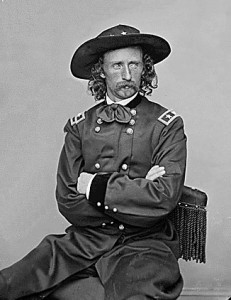 “We behold him now, on the verge of extinction, standing on his last foothold, clutching his rifle, resolved to die amidst the horrors of slaughter. And soon he will be talked of as a noble race who once existed but who has now passed away.”
George Armstrong Custer said that.
William Tecumseh Sherman, the Union general who, a few years before, broke the back of the Confederacy and who understood better than any military man in the 19th Century the concept of total war, now planned his strategy of Indian conquest. Sherman could be called the first modern day military terrorist. His march from Atlanta to the Atlantic targeted civilian populations and their property. Livestock was slaughtered and left to rot, the crops burned, the homes pillaged, and the women raped and murdered by Union troops. A hundred years later, the mere mention of Sherman’s name to a Southerner could end a friendship or stop a conversation.
Sherman took up the Indian cause with the same fervor. “We must act,” he said, “with vindictive earnestness against the Sioux, even to their extermination—men, women and children. Nothing else will do.”
Fathers, fathers…call back your young men. They have run over our country. They have destroyed the growing wood and the green grass. They have set fire to our lands. They have killed my animals–the elk, the deer, the antelope. My buffalo. They do not kill them to eat them. They leave them to rot where they fall….If I came to your country to kill your animals, what would you say? Would I not be wrong and would you not make war on me?
Bear Tooth
But techniques used against white civilians failed miserably with Native Americans. A campaign in 1867 to subdue the Indians cost the government $30 million and accomplished nothing but arouse the Native Americans to fight with even more urgency.
The army, frustrated by its inability to gain a military solution, began to offer treaties and compromises as a way of 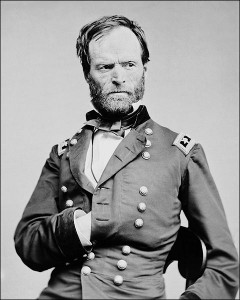 assuaging Indian concerns. The treaties were meaningless, especially to the U.S. Government who had no intention of honoring their commitments. It was just a stalling technique that Sherman came to understand and appreciate.
“Time will do more to settle the Indians,” Sherman observed, ” than anything we can do….we may have to concede to the Indians the right to hunt buffalos, as along as they last, and this may lead to collisions. But it won’t be long until all the buffalos are extinct.”
But when Sherman brought his old friend General Phil Sheridan west in 1868, he knew he had an ally and a man who shared his views on total war. He instructed Sheridan, “Go ahead in your own way and I will back you with my whole authority. The more Indians we can kill this year, the less will have to be killed next year. For the more I see of these Indians, the more I am convinced they will all have to be killed, or be maintained as a species of paupers.”
Sheridan sent his protege, George A. Custer to attack Indian encampments in Indian territory itself, where Native Americans believed themselves to be safe. Like Sand Creek, four years earlier, Custer killed more women and children than warriors and this time, the luckless Black Kettle was shot in the back. But Custer’s engagement was hailed a great victory and he gained notoriety as America’s most famous Indian Fighter.
By 1869, with the completion of the transcontinental railroad, the southern tribes began to collapse. Buffalo hunters, now able to haul their kills to eastern markets via the Union Pacific, killed the buffalo by the thousands. In one three year period, hunters killed eight million buffalo, simply for their hides, and left the carcasses to rot. Along the South Platte River, it was possible to walk on their bones for 200 miles without ever touching the ground.
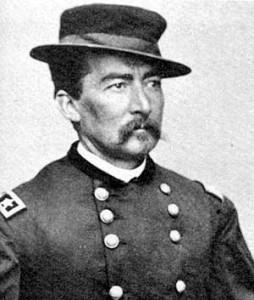 General Sheridan watched the slaughter with an eye to the future. “The hide hunters will do more,” he said, “to settle the vexed Indian question than the entire regular army has done in the last 30 years. For the sake of a lasting peace, let them kill, skin and sell until the buffalos are exterminated. Then your prairies can be covered with the speckled cattle and the festive cowboy, which follows the hunter as the forerunner of civilization.”
The Indians, stripped of their ability to feed themselves, turned desperately to the reservations. In Washington, President Grant was visited by a group of Quaker leaders who urged him to stop the army’s military campaign. They were convinced they could bring the Indians to Christianity and an agrarian life. The Quaker approach was as enlightened as it got in 1869. Grant agreed to let them try. “If you can make Quakers out of the Indians, it will take the fight out of them.”
It was, what historian Robert Utley called, “Conquest by kindness. If only we reason rationally with the Indians, they will recognize where their best interests lie and they will do what we want them to.”
The uneasy alliance between the U.S. Army and the various tribes of the northern plains lasted less than five years, when a crisis in the banking industry plunged the country into depression. White expansion into the mineral rich lands of the Northern Plains Indians seemed like a way out of the economic crisis and the public urged the government to act immediately. The Bismarck Tribune noted, “The American people need the country the Indians now occupy. The era of railroad building has been brought to termination by the greed of capitalists. Many of our people are unemployed and depression prevails on every hand. An Indian war would do no harm, for it must come sooner or later.”
And another newspaper editorial railed against the 1868 Indian treaty with the Lakota Sioux. “This abominable compact is seen as a barrier to the improvement and development of one of the richest and most fertile sections of America. What shall be done with these Indian dogs in our manger? They will not dig gold, or let others do it.”
In 1874, a “scientific expedition,” led by the most famous Indian fighter himself, George Custer, a thousand soldiers, a hundred wagons and a host of reporters, moved into the Black Hills country of Dakota. It was believed to contain a wealth of precious metals, including gold, but the land was protected by the Treaty of 1868, which gave these lands to Native Americans, for “as long as the grass grew and the rivers ran.”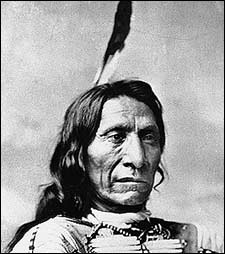
Custer came to test the waters. They found the gold they were in search of, reporters sent special stories to the press and within weeks, a new gold rush had ignited a frenzy. The government tried but failed to buy the land. The Lakota chief Red Cloud said, “The Black Hills are worth more than all the wild beasts and all the tame beasts in their possession of the white people. God placed those hills here for my wealth but now you want to take them from me and make me poor.”
President Grant, aware that public opinion now supported the invasion of the Black Hills for its gold, signed an executive order that forced the removal of all Indians in the Black Hills and onto reservations. He sent a terse memo, “Said Indians are hereby turned over to the War Department, for such action as you deem proper.” A final showdown loomed. Sherman wrote, “We all know that the time approaches for the battle that is to decide whether they or the United States is sovereign in the land they occupy.”
The Army organized a massive three-pronged attack to subdue the remaining free-roaming Indians–those who followed Sitting Bull, Crazy Horse, and other leaders who refused to give up the “old way of life.” The 7th Cavalry, led by Custer, moved confidently from Fort Abraham Lincoln; Custer was convinced the 7th “was about to see its finest hour.”
Wherever we went, the soldiers came to kill us and it was all our own country. It was ours already when the Wacishus made a treaty with Red Cloud, that said it was ours as long as the grass should grow and the waters flow. It was only eight years before and they were chasing us now because we remembered, and they forgot.
—Black Elk
General Crook moved north along the Rosebud River and was soundly defeated by Crazy Horse. At the Little Big Horn, Custer’s Crow scouts warned him that to attack the Indians here would be suicide. Custer replied, “The largest Indian encampment on the North American continent is ahead…and I am going to attack it.” By the end of the day, his entire regiment had been wiped out.
The U.S. Cavalry had attacked Native Americans, on their land, guaranteed by solemn treaty, but when word of Custer’s defeat reached the American people, his memory was transformed overnight. The arrogant, reckless, vain soldier whose ambition always over-rode logic and decency now became a gallant hero, dying with his boots on, making his “last stand” on Custer Hill, against a band of godless savages.
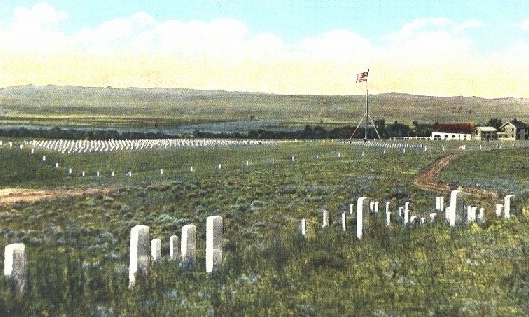
The Indians never lost a battle, but their victory at the Little Big Horn would be their death song as well. The Army now brought its full might to bear and the government unilaterally confiscated the Black Hills territory. Within a year, Crazy Horse would surrender and then be shot to death at Fort Robinson, Nebraska, Sitting Bull would escape to Canada with a small band of followers but, after a few years in exile and pushed to the edge of starvation, would surrender as well.
The near extermination of the buffalo, as Sheridan had prophesied, was as responsible for the Native American collapse, as anything else. In 1845, as many as 60 million buffalo roamed the Great Plains. By 1883, less than 200 could be found in all of the West.
For white Americans, it was not enough to defeat the Indians militarily; with the Native American population stripped of its ability to care for itself, stripping them of any identity at all became a primary objective. Even the “enlightened” whites were of little comfort to their vanquished foes. “It is not at this date in our power,” said General Randolph Marcy, “to atone for all the injustice inflicted on the Red Man, but it seems to me that a wise policy would dictate almost the only recompense that is in our power to make, that of introducing among them the light of Christianity and the blessings of civilization with their attendant benefits of agriculture and the arts.”
Not even the most progressive white man in 1877 could find a shred of value in Native American life. They were stripped of their customs and clothes and religion and even their language. Indian schools were established across the country and children were taken from their parents, to be taught Christian virtues and the concept of free enterprise.
The United States Congress ordered, “The Sun Dance shall be stricken down and the heathen idols shall give way to the Christian alters. The tribal organizations shall be broken up and the individuality of the Indian encouraged and developed. The lands unnecessarily given to them shall be open to the pioneer. That intelligence and thrift may find lodging there.”
When a race lies crushed and groaning under an alien yoke, how natural is it to dream of a redeemer, and author who shall return from exile or wake from a long sleep? To drive out the usurper and win back for his people what they have lost? The hope becomes a faith and the faith becomes the creed of prophets, until the hero is a god and the dream a religion, looking to some great miracle for its culmination and accomplishment.
—James Mooney
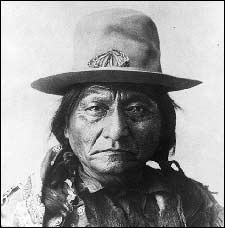 A year before his death, Sitting Bull said, “I would rather die an Indian than live as a white man.” In his last year, word spread across the reservations of a new religion that would save the Native America people and restore their lives to the way it once was. On January 1, 1889, a Paiute holy man named Wovoka became feverishly ill and a vision came to him during his delirium. He prophesied a Second Coming of Jesus, who this time would return to earth as a Red Man. Wovoka believed in the Ghost Dance. He believed that if Native Americans laid down their weapons and practiced non-violence, if they prayed hard enough, and if they performed the sacred Ghost Dance, their world would be re-born and their ancestors would come back from the dead. And that the whites would disappear.
The Ghost Dance came to the Lakota Sioux in the summer of 1890 and was enthusiastically embraced by them; as many as 5000 participated in the dances. And yet, while the Ghost Dance religion was, in many ways, the perfect _expression of non-violent Christian philosophy, white Americans feared it and, incredibly, prepared for war. The Indian agent at Pine Ridge, James McLaughlin, called the Ghost Dance, “demoralizing, disgusting and obscene,” and demanded government protection. By the end of November, a third of all the armed forces in the United States was on alert.
In mid-December, Sitting Bull, the leader of Indian resistance for more than 30 years, was murdered by Lakota soldiers hired by the whites to arrest him. His followers, fearful of more retribution fled south, toward Pine Ridge, Dakota. On December 29, 1890, a band of Lakota led by the ailing chief, Big Foot, found themselves surrounded by several hundred members of the 7th Cavalry at a place called Wounded Knee Creek. The soldiers placed six Hotchkiss cannons on the ridge above Big Foot’s camp. An uneasy truce carried through the night, but the next morning, as soldiers rifled the Indians’ belongings, looking for weapons, a shot went off—who fired it was never known—and 100 soldiers opened fire on the crowd of Indians below. Big Foot died where he lay. Warriors and soldiers traded shots until there were no warriors left to fire. The lop-sided battle became a massacre. Women and children fled the scene in terror as soldiers shot them from the top of the ravines. Of the 350 men, women and children in Big Foot’s band, all but 100 were gunned down by the soldiers or cut to pieces by the Hotchkiss cannons. Some of the dead women and their children were found as far as three miles away, shot dead as they ran.
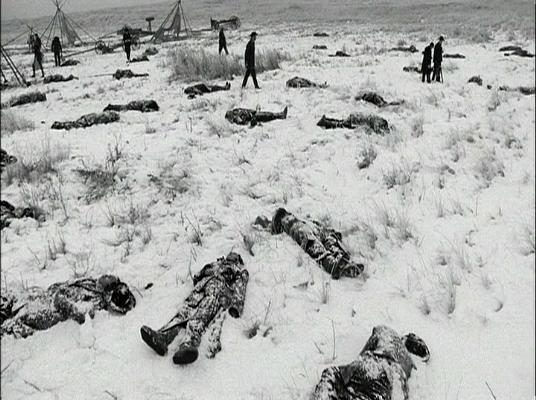
Later, the U.S. Congress awarded 25 members of the Cavalry the Congressional Medal of Honor for their “valor” at Wounded Knee.
And so it was all over. I did not know then how much was ended. But when I look back now from this high hill of my old age, I can still see the butchered women and children, lying in a heap and scattered all along the crooked gulch, as plain as when I saw them, with eyes still young. And I can see that something else died there in the bloody mud. A people’s dream died there. It was a beautiful dream, and I to whom so great a vision was given in my youth…you see me now, a pitiful old man, who has done nothing. For the nation’s hoop is broken and scattered. There is no center any longer and the sacred tree is dead.
—Black Elk
Indian resistance to white Christian culture ended brutally that day. We could not see the value in a way of life that didn’t mirror our own and so Americans chose to destroy it, by any means possible. It took everything away from Native Americans but what survives in their hearts—we could never claim that.
What about today? Has Christian America evolved? Did it learn a lesson from the 19th Century? Have we been able to separate adversity from diversity? Do we understand the difference between an enemy and one who simply doesn’t agree with us? Consider these sentiments, after 9/11…
“This is no time to be precious about locating the exact individuals directly involved in this terrorist attack…We should invade their countries, kill their leaders and convert them to Christianity. We weren’t punctilious about locating and punishing only Hitler and his top officials. We carpet-bombed German cities, we killed civilians. That’s war, and this is war.”
Ann Coulter, a conservative columnist, held in high regard by the Christian religious right, wrote that in The National Review, America’s “premiere conservative web site.” She sounds just like General Sherman, 135 years ago.
Have we evolved in the last century as a “Christian nation?” And are we really any less violent or judgmental than the millions we condemn?
I can’t help but recall the admonition from Jesus Christ to his disciples: “Do not look for the speck in your brother’s eye. Consider the log in your own.” The Ghost Dancers understood far better than we do.
SOURCE MATERIAL FOR THIS STORY:
THE INDIAN FRONTIER of the American West: 1846-1890 By Robert Utley
THE WEST By Geoffrey C. Ward
SHERMAN By Lee Kennett
THE TIME OF THE BUFFALO By Tom McHugh
THE WAY WEST…A documentary film for The American Experience (PBS) By Ric Burns
THE WEST…A documentary film for The American Experience (PBS) By Steven Ives
The Feb/Mar Zephyr (click the cover)